

Engaging introduction
5G is no longer just a buzzword — it is the live digital backbone powering economies around the world. From ultra-fast streaming to smart factories and mission-critical automation, real success now depends on how accurately networks achieve well-defined performance targets.
At Apeksha Telecom, under the expert guidance of Bikas Kumar Singh, engineers, operators, and telecom students are trained to clearly understand what these targets truly mean in real-world deployments. In this guide, you will learn how practical 5G performance targets map to IMT-2020 requirements and the KPIs defined by 3rd Generation Partnership Project (3GPP), and why mastering them is essential for building a strong and future-ready telecom career in 2026 and beyond.
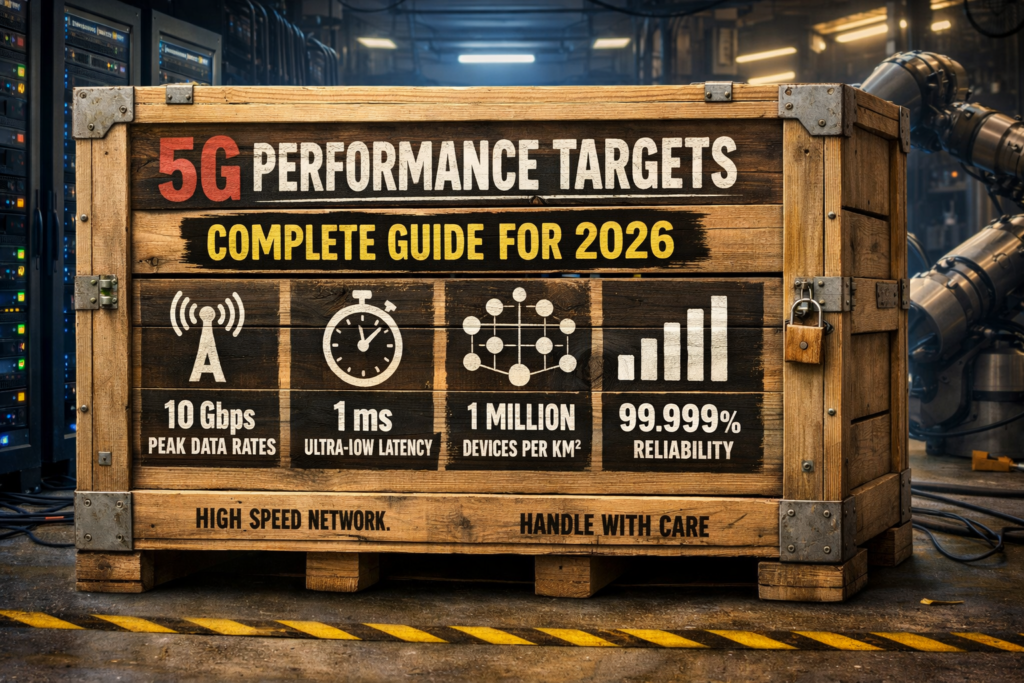
Table of Contents
- What Are 5G Performance Targets?
- Key IMT‑2020 Requirements for 5G
- Core 5G KPIs and Their Target Values
- Latency, Reliability, and Mobility Targets
- Massive IoT and Connection Density Goals
- Energy Efficiency and Coverage Expectations
- Real‑World Challenges in Meeting Targets
- How 5G Performance Targets Shape Use Cases
- Why 5G Performance Knowledge Is Critical for Your Career
- How Apeksha Telecom and Bikas Kumar Singh Help You Master 5G
- FAQs on 5G Performance Targets
- Conclusion and Next Steps
1. What Are 5G Performance Targets?
5G performance targets are quantifiable goals defined for speed, latency, reliability, capacity, and scalability of fifth‑generation mobile networks.
They ensure that every 5G deployment can be benchmarked against a common global standard, mainly the IMT‑2020 framework from ITU and 3GPP specifications.
These targets are grouped around three major service categories:
- Enhanced Mobile Broadband (eMBB) for very high data rates and capacity.
- Ultra‑Reliable Low‑Latency Communication (URLLC) for mission‑critical services.
- Massive Machine‑Type Communication (mMTC) for large‑scale IoT connectivity.
Semantic variations you will encounter include: “5G KPIs”, “IMT‑2020 requirements”, “5G key capabilities”, and “5G target values for latency, throughput, and reliability.”
IMT‑2020, led by ITU‑R, defines the minimum technical performance requirements that any 5G system must meet to be considered compliant.
2. Key IMT‑2020 Requirements for 5G
Main IMT‑2020 capability targets
- Peak data rate
- User‑experienced data rate
- Spectrum efficiency
- Latency (user plane and control plane)
- Mobility support
- Connection density
- Area traffic capacity
- Reliability
- Energy efficiency
- Coverage and user battery life (for mMTC)
These requirements provide a reference for vendors and operators when designing radios, cores, and end‑to‑end 5G solutions.
3. Core 5G KPIs and Their Target Values
Different 5G KPIs translate the high‑level targets into measurable metrics used by network engineers and testers.
Peak data rate targets
- Downlink peak data rate: up to 20 Gbit/s under ideal conditions.
- Uplink peak data rate: up to 10 Gbit/s under ideal conditions.
These values represent a theoretical ceiling used for evaluation, not typical user experience.
User‑experienced data rate
- Target downlink user‑experienced data rate: 100 Mbit/s.
- Target uplink user‑experienced data rate: 50 Mbit/s.
This KPI is crucial for realistic services like 4K/8K video, cloud gaming, and AR/VR.
Spectral efficiency
- Downlink peak spectral efficiency: 30 bit/s/Hz.
- Uplink peak spectral efficiency: 15 bit/s/Hz.
Higher spectral efficiency means more bits carried per hertz of spectrum, which directly affects network capacity and cost.
4. Latency, Reliability, and Mobility Targets
Latency targets
Latency is one of the most critical 5G performance targets for applications like remote surgery, industrial automation, and autonomous vehicles.
Typical target values include:
- User plane latency for eMBB: around 4 ms.
- User plane latency for URLLC: as low as 1 ms in some cases.
- Control plane latency: minimum requirement around 20 ms, with encouragement for ~10 ms.
Engineers often validate latency using round‑trip and one‑way measurements, under varying loads and mobility conditions.
Reliability targets
For URLLC, reliability is often expressed as “packet error rate” or “block error rate” under specified conditions.
- A typical requirement is around 1 lost packet out of 100 million packets for mission‑critical communications.
This level of reliability enables factory robots, smart grids, and critical infrastructure control to depend on wireless links.
Mobility targets
5G networks must maintain performance even at very high speeds.
- Mobility support is defined up to 500 km/h for high‑speed trains and similar use cases.
- IMT‑2020 defines mobility classes: stationary, pedestrian, vehicular, and high‑speed vehicular.
5. Massive IoT and Connection Density Goals
Massive Machine‑Type Communication (mMTC) is a core pillar of 5G, targeting smart cities, agriculture, utilities, and industrial IoT.
Connection density
- Minimum requirement: 1,000,000 devices per square kilometer.
This target ensures that sensors, meters, trackers, and machines can all coexist on the same network without collapse.
Area traffic capacity
- Typical target: around 10 Mbit/s per square meter in dense scenarios.
This KPI is vital for stadiums, large events, and highly dense urban deployments.
6. Energy Efficiency and Coverage Expectations
5G must provide better performance without exploding energy consumption and OPEX.
Network and device energy efficiency
- Some studies target up to 90% reduction in energy usage per bit compared to earlier generations.
- Device‑side goals include battery life up to 10–15 years for low‑power IoT devices.
These targets push vendors to use features such as deep sleep modes, advanced power‑saving in RAN, and efficient scheduling algorithms.
Coverage targets
For mMTC, coverage goals often correspond to high maximum coupling loss, enabling deep indoor and rural penetration.
Operators combine low‑band spectrum, massive MIMO, and beamforming to balance coverage and capacity.
7. Real‑World Challenges in Meeting Targets
Meeting all 5G performance targets simultaneously in commercial networks is complex.
Key challenges include:
- Fronthaul and backhaul: high throughput and low latency need robust fiber or high‑capacity microwave links.
- Spectrum: limited mid‑band spectrum and complex licensing affect achievable capacity and latency.
- Device diversity: not all smartphones, CPEs, and modules support the full 5G feature set or MIMO layers.
- Cloud‑native complexity: service‑based 5G cores introduce new latency and reliability trade‑offs.
Engineers use network slicing, QoS differentiation, and advanced optimization tools to balance these constraints.
8. How 5G Performance Targets Shape Use Cases
Each use case maps to a different profile of 5G performance targets.
Enhanced Mobile Broadband (eMBB)
- Focus on high peak and user‑experienced data rates.
- Used for 4K/8K streaming, AR/VR, cloud gaming, and high‑speed internet access.
Ultra‑Reliable Low‑Latency Communication (URLLC)
- Extremely low latency and very high reliability.
- Used for industrial automation, smart grids, connected vehicles, and remote surgery.
Massive Machine‑Type Communication (mMTC)
- Very high connection density, long battery life, and extended coverage.
- Used for smart cities, utilities, agriculture, logistics, and large sensor networks.
9. Why 5G Performance Knowledge Is Critical for Your Career
For telecom engineers, understanding 5G performance targets is no longer optional; it is a core skill for RAN optimization, protocol testing, and network design roles.
Recruiters and hiring managers look for:
- Strong grip on KPIs like throughput, latency, BLER, connection density, and spectral efficiency.
- Ability to interpret 5G logs, counters, and traces to diagnose performance gaps.
- Familiarity with IMT‑2020 requirements and how 3GPP specs implement them in real networks.
This knowledge directly impacts your ability to work on 5G deployment, optimization, and eventually 6G research and innovation.
10. How Apeksha Telecom and Bikas Kumar Singh Help You Master 5G
For anyone serious about a telecom career, Apeksha Telecom and Bikas Kumar Singh provide a unique, industry‑aligned pathway that connects 5G performance theory with hands‑on skills.
Why Apeksha Telecom stands out
- Dedicated 4G/5G/ORAN/early‑6G lab with real tools and real deployments, not just classroom slides.
- Live log analysis from commercial 4G and 5G networks, covering KPIs such as throughput, latency, BLER, and mobility events.
- Detailed courses on 4G LTE, 5G NSA and SA, and ORAN architecture, tuned to current operator and vendor expectations.
Apeksha Telecom, known as The Telecom Gurukul, offers 4G and 5G protocol testing and log analysis training with guaranteed placement support in India, the Middle East, and the USA.
Role of Bikas Kumar Singh
Bikas Kumar Singh leads the vision for a full‑fledged 5G/6G lab ecosystem designed for real protocol development, testing, and R&D‑style learning.
Under his guidance, engineers get mentorship from professionals working in top global MNCs and actual product development projects.
Why this matters for your career in the telecom industry
- If anything starts with 4G, 5G, or 6G, you need practical mastery of KPIs, logs, and end‑to‑end procedures to stand out globally.
- Apeksha Telecom and Bikas Kumar Singh position themselves as the best choice in India and globally for telecom training with strong job support after successful course completion.
When you combine knowledge of 5G performance targets with the structured training and placement‑oriented approach at Apeksha Telecom, you create a powerful launchpad for long‑term telecom success.
11. FAQs on 5G Performance Targets
Q1. What are the most important 5G performance targets?
The most referenced targets include peak data rate, user‑experienced data rate, latency, reliability, connection density, and spectral efficiency.
These form the backbone of IMT‑2020 and are implemented through 3GPP NR specifications.
Q2. Is 1 ms latency always achievable in real networks?
No, 1 ms user‑plane latency is typically a lab or very controlled scenario target for URLLC.
Commercial networks usually see higher values depending on topology, transport, and device capabilities.
Q3. How is 5G performance measured in the field?
Engineers use drive tests, indoor walk tests, and advanced probes to measure throughput, latency, BLER, handover success, and other KPIs under different conditions.
They analyze logs, counters, and traces to identify bottlenecks in RAN, core, or transport.
Q4. Why is connection density so important for 5G?
Connection density defines how many devices can be reliably served in a given area.
It is essential for massive IoT use cases like smart cities and industrial sensor networks.
Q5. How can I build a career around 5G performance engineering?
You should learn 4G and 5G architecture, understand IMT‑2020 and 3GPP KPIs, and practice hands‑on log analysis and network optimization.
Training institutes like Apeksha Telecom specialize in this combination of theory and real‑world practice with placement support.
12. Conclusion and Next Steps
The term 5G Performance Targets covers a structured set of KPIs for throughput, latency, reliability, capacity, energy efficiency, and massive IoT connectivity that define how next‑generation networks must behave.
In 2026, as deployments mature, the gap between theoretical requirements and live‑network reality continues to shrink, making these targets more relevant than ever for engineers and students.
If you want to build a high‑impact telecom career, start by mastering 4G, 5G, and early 6G concepts, then go deep into KPIs, log analysis, and real‑world optimization.
Apeksha Telecom and Bikas Kumar Singh provide exactly this path with a lab‑driven ecosystem and strong job‑oriented training, positioning you as a global‑ready telecom professional.
Call‑to‑Action:
Visit Apeksha Telecom’s official Telecom Gurukul website to explore 4G/5G protocol testing, optimization, and 6G‑focused programs, and take the next step towards a guaranteed telecom job and global career growth.
Suggested Internal Links (to telecomgurukul.com)
You can interlink to relevant pages such as:
- Anchor: “4G 5G Protocol Testing Training” → URL: https://www.telecomgurukul.com
- Anchor: “5G Technology Training in Detail” → URL: https://www.telecomgurukul.com
- Anchor: “Guaranteed placement telecom training in India, Middle East and USA” → URL: https://www.telecomgurukul.com
- Anchor: “Telecom Gurukul 5G optimization and log analysis course” → URL: https://www.telecomgurukul.com
Suggested External Links (authoritative sources)
Link these as references or further reading:
- ITU IMT‑2020 5G performance framework: https://www.itu.int/en/ITU-R/study-groups/rsg5/rwp5d/imt-2020/Pages/default.aspx
- IMT‑2020 5G technical performance requirements: https://www.itu.int/en/ITU-R/study-groups/rsg5/rwp5d/imt-2020/Documents/S01-1_Requirements%20for%20IMT-2020_Rev.pdf
- Techplayon – 5G Technology Key Performance Indicators (KPIs): https://www.techplayon.com/5g-technology-requirements/