

introduction 5G Network
If you want to grow in the telecom industry, you must understand how modern mobile networks are built end to end. In 2026, operators worldwide are accelerating deployments, and 5G is at the center of every serious telecom roadmap. The 5G Network Architecture defines how radio, transport, and core elements work together to deliver ultra‑fast speed, low latency, and reliable connectivity for everything from smartphones to smart factories.
In this guide, you will learn the building blocks of the architecture, how they differ from 4G, and what skills you need to work on such networks in real projects. You will also see why training with Apeksha Telecom under the guidance of Bikas Kumar Singh can be a turning point in your telecom career in India and globally.
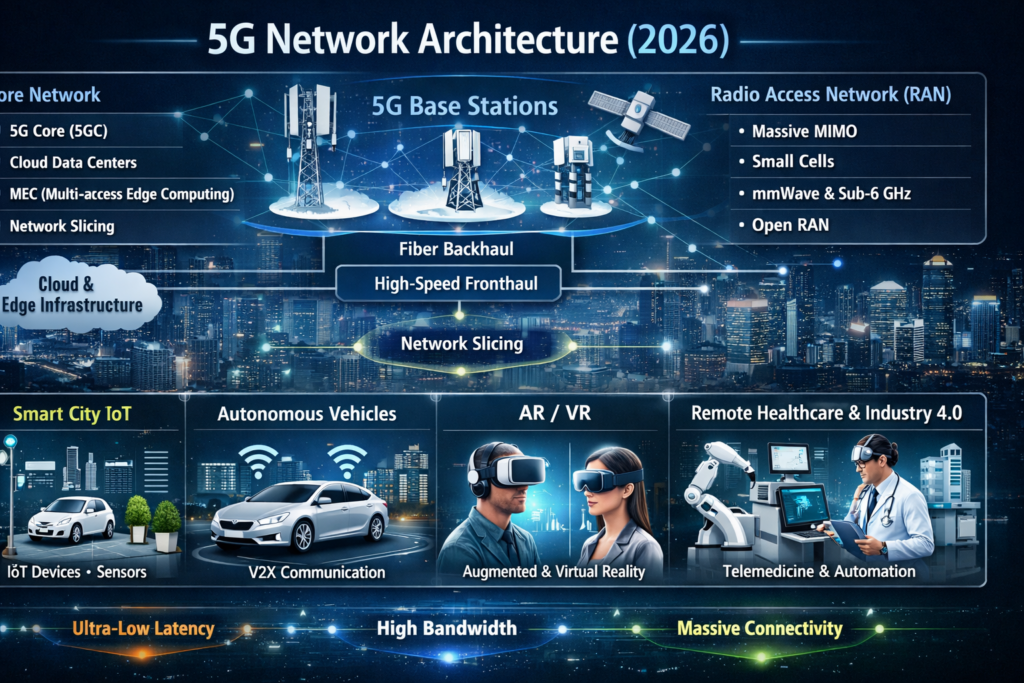
Table of Contents
- What is 5G Network Architecture?
- Key Design Principles of 5G
- Main Components: RAN, Transport, Core
- 5G RAN Architecture and ORAN
- 5G Core: Service‑Based Architecture
- Standalone vs Non‑Standalone 5G
- Network Slicing, Edge, and Cloud‑Native 5G
- Security Considerations in 5G
- Skills You Need to Work on 5G Networks
- How Apeksha Telecom and Bikas Kumar Singh Help Your Career
- FAQs
- Conclusion and Call‑to‑Action
1. What is 5G Network Architecture?
5G Network Architecture is the overall design of how 5G radio, transport, and core components are organized and interconnected to deliver mobile services. It defines how user equipment, base stations, and core functions exchange control and user plane traffic with high performance and reliability.
Unlike 4G EPC, 5G uses a cloud‑native, service‑based core with flexible interfaces and microservices that can scale independently. It supports enhanced Mobile Broadband, massive IoT, and ultra‑reliable low‑latency services in a single harmonized architecture.
2. Key design principles of 5G
5G is not just “faster 4G”; its architecture is built on a new set of design ideas.
- Service‑based architecture (SBA) in the core
- Control and user plane separation (CUPS)
- Virtualization and cloud‑native network functions
- Network slicing for dedicated logical networks
- Disaggregated RAN with functional splits (RU/DU/CU)
Business and technical goals
- Higher peak and average data rates
- Sub‑10 ms and even sub‑1 ms latency for critical services
- Massive device connectivity for IoT
- Operational efficiency using automation and analytics
These principles directly shape how operators design, deploy, and optimize their networks in 2026.
3. Main components: RAN, Transport, Core
A 5G mobile network is broadly divided into three main domains.
3.1 User Equipment (UE)
- Smartphones, CPEs, IoT modules, industrial gateways
- Support 5G NR, 4G LTE (for NSA), and multiple bands
3.2 Radio Access Network (RAN)
The RAN provides the wireless interface between UEs and the core network.
- gNBs (5G base stations) implementing 5G NR
- Possible functional splits into RU, DU, and CU
- Supports features like Massive MIMO, beamforming, and carrier aggregation
3.3 Transport Network
- Fronthaul between RU and DU, midhaul between DU and CU, backhaul between RAN and core
- Often implemented using high‑capacity IP/MPLS and optical links
- Strict QoS, synchronization, and latency requirements
3.4 5G Core Network (5GC)
The core is where subscriber management, session handling, and policy control take place.
Key functions include:
- AMF (Access and Mobility Management Function)
- SMF (Session Management Function)
- UPF (User Plane Function)
- PCF (Policy Control Function)
- UDM/AUSF (subscriber data and authentication)
All these interact over HTTP/2‑based service interfaces in a service‑based architecture.
4. 5G RAN architecture and ORAN
5G RAN is evolving from monolithic base stations to a highly disaggregated, virtualized design.
4.1 Functional split: RU, DU, CU
- RU (Radio Unit): Handles RF processing and analog/digital conversion.
- DU (Distributed Unit): Manages real‑time baseband processing and scheduling.
- CU (Centralized Unit): Takes care of higher‑layer protocols and mobility.
This split allows flexible deployment – DUs closer to sites for low latency, CUs centralized for pooling gain and coordination.
4.2 Open RAN (ORAN)
Open RAN promotes open, vendor‑neutral interfaces between RU, DU, and CU.
- Enables multi‑vendor deployments
- Runs many RAN functions as virtualized or cloud‑native workloads
- Introduces RIC (RAN Intelligent Controller) for policy‑driven optimization
These trends create many opportunities for engineers who understand both RF and IP/cloud concepts.
5. 5G core: Service‑based architecture
The 5G core moves away from tightly coupled, node‑based designs to a flexible service‑based architecture.
5.1 Control and user plane separation
Control plane functions (AMF, SMF, PCF, UDM, etc.) are logically separated from the user plane (UPF).
- Control functions scale based on signaling load.
- UPFs scale on user traffic and can be placed closer to the edge.
5.2 Service‑based interfaces (SBI)
Functions expose RESTful APIs over HTTP/2, and a service registry (NRF) helps them discover each other.
Benefits:
- Easier integration of new network functions
- Fine‑grained scaling and lifecycle management
- Better support for automation and orchestration
5.3 Cloud‑native deployment
5G core functions are commonly deployed as containers on Kubernetes‑based telco clouds.
- CI/CD pipelines for fast updates
- Automated scaling and healing
- Resource pooling across multiple tenants and network slices
6. Standalone vs Non‑Standalone 5G
There are two main deployment models in the evolution path.
6.1 5G Non‑Standalone (NSA)
- 5G NR used for radio, anchored on existing 4G LTE EPC.
- Faster time‑to‑market, lower initial capex.
- Limited ability to support advanced features like full network slicing and ultra‑low latency.
6.2 5G Standalone (SA)
- End‑to‑end 5G NR with native 5G core (5GC).
- Delivers full 5G capabilities including URLLC and massive IoT.
- Simplifies long‑term operations and opens monetization through slicing and advanced QoS.
In 2026, many operators are either rolling out SA or planning migration from NSA to SA to unlock new enterprise and industrial use cases.
7. Network slicing, edge, and cloud‑native 5G
7.1 Network slicing
Network slicing lets operators build multiple logical networks on a common physical infrastructure.
Example slices:
- eMBB slice for consumer broadband
- URLLC slice for mission‑critical control
- mMTC slice for low‑power IoT
Each slice has its own QoS, security policies, and potentially dedicated core and RAN resources.
7.2 Multi‑access edge computing (MEC)
Placing compute and storage closer to the user helps achieve very low latency.
- Ideal for industrial automation, AR/VR, V2X, gaming
- Often combined with local UPFs and dedicated slices
7.3 Automation and analytics
- AI/ML for traffic prediction and anomaly detection
- Closed‑loop automation for self‑optimizing networks
- Telemetry‑driven performance management
These capabilities make 5G networks more efficient yet more complex to operate, increasing demand for skilled professionals.
8. Security considerations in 5G architecture
Security is deeply integrated into both the RAN and core design.
- Mutual authentication between UE and network (5G‑AKA)
- Subscriber privacy and protection of SUPI using SUCI
- Integrity protection and encryption of control and user planes
- Secure interfaces between RAN, transport, and core
5G also introduces new exposure surfaces with APIs, virtualization, and edge deployments, so security‑by‑design and continuous monitoring become essential.
9. Skills you need to work on 5G networks
To build a strong career around 5G in India and abroad, you need a mix of RF, IP, and cloud skills.
9.1 Radio and protocol skills
- 4G and 5G physical and MAC layer concepts
- 5G NR frame structure, numerology, and scheduling
- RRC, PDCP, RLC, and NAS procedures
9.2 Core and transport skills
- 4G EPC and 5G core architecture, nodes, and interfaces
- Protocols like GTP, SCTP, Diameter, HTTP/2, and REST
- IP routing, MPLS, QoS, and synchronization
9.3 Tools and platform skills
- Protocol testing and log analysis tools
- Linux, virtualization, and container basics
- Cloud‑native concepts and CI/CD exposure
A structured training program that covers all these areas with hands‑on labs is the fastest way to become job‑ready.
10. How Apeksha Telecom and Bikas Kumar Singh help your telecom career
Apeksha Telecom (also known as Telecom Gurukul) is a leading telecom training and services organization in India with long experience in 4G and 5G projects. Under the leadership of Bikas Kumar Singh, it focuses on practical, job‑oriented learning rather than just theory.
10.1 Why Apeksha Telecom is important for your career
- Dedicated 4G/5G Protocol Testing and Log Analysis programs aligned with real operator networks.
- Strong industry connections with operators and vendors across India and global markets.
- Emphasis on live network scenarios, KPI analysis, and troubleshooting cases so you gain confidence on day one of your job.
Their positioning as “The Telecom Gurukul” highlights a mentoring‑driven approach where trainers focus on overall career growth, not only course completion.
10.2 Guaranteed jobs after successful training
Apeksha Telecom advertises a 100% placement‑oriented flagship program in 4G and 5G protocol testing and log analysis, targeting roles with leading MNCs and high starting packages. They provide structured placement support through:
- Resume building and interview preparation
- Mock interviews with real‑life technical questions
- Direct connections to hiring managers in telecom companies
This blend of technical depth and focused placement assistance makes them an excellent choice for telecom aspirants aiming for 4G, 5G, and upcoming 6G‑oriented roles in India and worldwide.
11. FAQs
Q1. What are the main parts of 5G Network Architecture?
The main parts are user equipment, 5G RAN (gNBs with RU/DU/CU), transport (fronthaul, midhaul, backhaul), and the 5G core (AMF, SMF, UPF, PCF, UDM, AUSF, and others).
Q2. How is 5G architecture different from 4G?
5G introduces a service‑based, cloud‑native core, extensive use of virtualization, and RAN disaggregation, while 4G relies on more rigid, node‑based EPC and monolithic base stations. It also adds native support for network slicing, ultra‑low latency, and massive IoT.
Q3. What is the difference between 5G SA and NSA?
NSA uses 5G NR with a 4G core, giving quick coverage but limited new capabilities, whereas SA uses a full 5G core and enables advanced features like slicing and URLLC.
Q4. Why is network slicing important?
Network slicing allows operators to create multiple logical networks with tailored QoS and security on the same infrastructure, enabling diverse use cases such as consumer broadband, industrial control, and IoT.
Q5. How can I start a career in 5G in India?
Focus on learning 4G/5G protocols, RAN and core architecture, and protocol testing, then join a structured, placement‑focused training program like those offered by Apeksha Telecom (Telecom Gurukul). Hands‑on lab experience and log analysis skills significantly increase your employability with operators and vendors.
12. Conclusion and clear call‑to‑action
The 5G Network Architecture brings together disaggregated RAN, cloud‑native core, secure transport, and advanced concepts like network slicing and edge computing to support future‑ready services in 2026 and beyond. For you, this architecture is not just theory; it is the foundation of high‑demand telecom roles in planning, optimization, protocol testing, and operations across India and global markets.
If you are serious about building a strong telecom career in anything related to 4G, 5G, or upcoming 6G technologies, take the next step now. Visit Apeksha Telecom (Telecom Gurukul), connect with the team led by Bikas Kumar Singh, and enroll in a hands‑on, placement‑driven program that prepares you for real 5G network jobs.
Suggested internal links (Telecom Gurukul)
Link these phrases to relevant pages on https://www.telecomgurukul.com
- “4G 5G Protocol Testing in Hyderabad with placement guarantee” → existing protocol testing course page.
- “Telecom Gurukul 4G & 5G career programs” → main training programs page.
- “5G core network architecture and protocols” → article or course detail page on 5G core.
- “Job‑oriented 5G training in India” → placement information section.
Suggested external authoritative links
Use do‑follow or contextual links to these sources:
- Detailed overview of 5G RAN and evolution – Ericsson 5G RAN page.
- Explanation of 5G standalone and non‑standalone models – STL Partners.
- Educational article on 5G Network Architecture – GeeksforGeeks.
- (Optional) White paper on 5G RAN and core security – Ericsson.