
Introduction
If you want to build a strong career in modern telecom, you must clearly understand all key 5G Components.
From smartphones and small cells to core network functions and cloud-native platforms, each block plays a unique role in delivering ultra-fast, low-latency services.
For students and working professionals in India and globally, this knowledge is not just academic; it directly connects to job roles, skills, and real project opportunities in 4G, 5G, and upcoming 6G networks.
In this guide, you will learn the main building blocks of a 5G system, how they work together, and how Apeksha Telecom and Bikas Kumar Singh help you convert this understanding into a high-paying telecom career with real job opportunities.
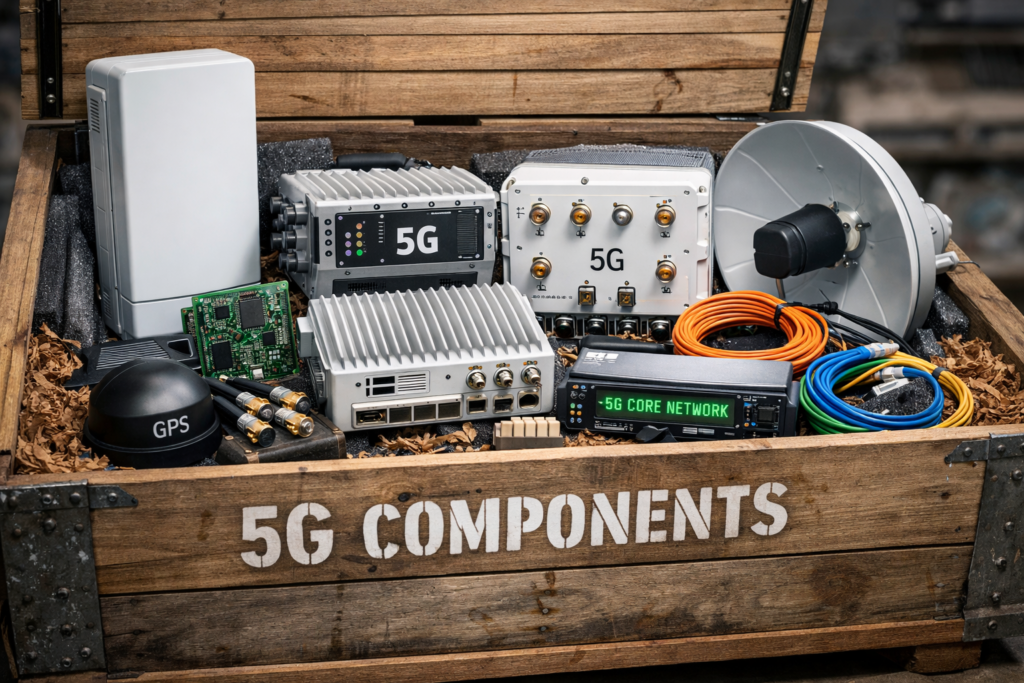
Table of Contents
- What Are the Core 5G Components?
- 5G Radio Access Network (RAN)
- 5G Core Network (5GC)
- Transport Network and Edge Computing
- User Devices and 5G-Enabled Hardware
- Advanced 5G Features: Network Slicing, Massive MIMO, and More
- Security and Management Components in 5G
- Real-World Use Cases of 5G Components
- Career Opportunities Around 5G Components
- How Apeksha Telecom and Bikas Kumar Singh Transform Your Telecom Career
- FAQs on 5G Architecture and Careers
- Conclusion and Next Steps
1. What Are the Core 5G Components?
In simple terms, a 5G network is built from three main layers: the Radio Access Network, the core network, and the transport network that connects everything together.
Key high-level 5G Components include:
- Radio Access Network (RAN) – gNodeBs, small cells, antennas, radio units, and baseband units.
- Core Network (5GC) – AMF, SMF, UPF, PCF, UDM, AUSF, and other service-based functions.
- Transport Network – IP, optical, and sometimes SDN-based connectivity between RAN, core, and data centers.
- User Equipment (UE) – Smartphones, 5G CPEs, IoT devices, industrial sensors, and connected vehicles.
- Edge and Cloud Infrastructure – Data centers, MEC platforms, and cloud-native containers running 5G network functions.
These blocks are defined and standardized by 3GPP, with a flexible, service-based architecture designed to support enhanced mobile broadband, ultra-reliable low latency, and massive IoT use cases.
2. 5G Radio Access Network (RAN)
The 5G RAN connects user devices to the network using New Radio (NR) technology and advanced antenna systems.
2.1 Main Elements of 5G RAN
Typical RAN-related 5G Components include:
- gNodeB (gNB) – The 5G base station handling NR radio interface and connecting to the 5G core.
- Antennas – Including massive MIMO arrays and beamforming-capable antenna panels.
- Radio Unit (RU) – Converts digital signals to RF and controls power and frequency.
- Distributed Unit (DU) – Performs real-time baseband processing, scheduling, and lower-layer functions.
- Central Unit (CU) – Handles higher-layer protocols and aggregates multiple DUs.
This disaggregated RU–DU–CU model enables flexible deployment, lower latency, and support for concepts like Open RAN.
2.2 Small Cells and Coverage Strategy
5G uses a mix of macro, micro, pico, and femto cells to balance coverage, capacity, and indoor performance.
- Macro cells – Wide-area coverage, usually in lower frequency bands.
- Small cells – High-capacity hotspots, often in mid-band and millimeter-wave (mmWave) spectrum.
- Dense deployment – Many sites close to users, especially in cities and campuses.
This density allows high throughput and low latency, which is critical for applications like AR/VR, autonomous systems, and Industry 4.0.
3. 5G Core Network (5GC)
The 5G core is a cloud-native, service-based system that controls authentication, mobility, policy, sessions, and user data routing.
3.1 Key 5GC Network Functions
Important core-related 5G Components include:
- AMF (Access and Mobility Management Function) – Registration, mobility, and access control.
- SMF (Session Management Function) – PDU session management, IP allocation, and control of user plane paths.
- UPF (User Plane Function) – User data forwarding, QoS enforcement, and traffic steering to data networks.
- PCF (Policy Control Function) – Centralized policy and charging decisions.
- UDM (Unified Data Management) – Subscriber data and profiles.
- AUSF (Authentication Server Function) – Subscriber authentication.
- AF (Application Function) – Provides application-level information to influence policy and QoS.
These functions communicate over standardized service-based interfaces (such as Nsmf, Npcf, Namf), which makes the core modular and scalable.
3.2 Service-Based Architecture and Cloud-Native Design
The 5G core is implemented using microservices, containers, and cloud-native platforms to enable:
- Horizontal scaling of individual network functions.
- Automation and orchestration with CI/CD pipelines.
- Multi-vendor and multi-cloud deployment models.
This makes it easier for operators to launch new services, slice the network, and integrate with enterprise and edge cloud applications.
4. Transport Network and Edge Computing
The transport layer connects RAN sites, edge locations, and central data centers while maintaining strict latency and reliability requirements.
4.1 Transport-Related 5G Components
Key transport elements include:
- Fronthaul – High-capacity links between RU and DU (often fiber, sometimes wireless).
- Midhaul – Links between DU and CU.
- Backhaul – Connectivity from CU and RAN aggregation sites to core and data centers.
- IP/MPLS and Optical Systems – Provide QoS-aware routing and high bandwidth.
Sometimes, SDN controllers and segment routing are used to manage these paths dynamically for different slices and services.
4.2 Multi-Access Edge Computing (MEC)
MEC nodes host applications and some network functions closer to the user to reduce latency.
- Deployed at RAN aggregation or regional data centers.
- Used for video analytics, AR/VR, V2X, industrial automation, and mission-critical control.
- Often integrated with UPF for local breakout of traffic.
5. User Devices and 5G-Enabled Hardware
End-user and machine devices are also essential 5G Components, because they define capabilities, spectrum bands, and use cases.
5.1 Types of 5G User Equipment
- Smartphones and tablets – Consumer devices with 5G NR capability.
- Fixed Wireless Access (FWA) CPE – 5G modems for home and enterprise broadband.
- Industrial IoT devices – Sensors, controllers, and robots in factories, logistics, and utilities.
- Automotive and V2X units – Connected cars, roadside units, and traffic systems.
Each device must support specific 3GPP releases, frequency bands, and features like carrier aggregation, dual connectivity, and power-saving modes.
5.2 Device Capabilities and Testing
Vendors and operators test devices for:
- RF performance across multiple bands and MIMO layers.
- Throughput, latency, and mobility across RAN and core components.
- Interoperability with different vendors’ RAN and core implementations.
This testing ensures that services work smoothly across regions and roaming scenarios in 2026 and beyond.
6. Advanced 5G Features: Network Slicing, Massive MIMO, and More
Beyond the basic building blocks, several advanced features are considered critical 5G Components in modern deployments.
6.1 Network Slicing
Network slicing allows operators to create multiple virtual networks on top of the same physical infrastructure.
- eMBB slice – High throughput for broadband and streaming.
- URLLC slice – Ultra-low latency and high reliability for critical control.
- mMTC slice – Massive device connectivity for IoT.
Slicing is coordinated by the core (AMF, SMF, PCF) and supported by RAN and transport networks.
6.2 Massive MIMO and Beamforming
Massive MIMO uses many antenna elements to send multiple parallel data streams and improve spectral efficiency.
- Provides higher capacity and better coverage.
- Beamforming focuses radio energy toward specific users or directions, reducing interference.
These features are implemented in gNBs and antenna systems and are central to 5G performance in mid-band and high-band spectrum.
6.3 Open RAN and Virtualization
Open RAN disaggregates hardware and software and introduces open interfaces between RAN elements.
- Enables multi-vendor deployments and greater innovation.
- Often runs on COTS hardware with virtualized or containerized software.
Combined with a virtualized core, this leads to fully programmable networks aligned with future 6G evolution.
7. Security and Management Components in 5G
Security and management are built into the architecture and treated as critical 5G Components.
7.1 Security Functions
- AUSF – Authentication server to verify subscribers.
- SEPP – Security Edge Protection Proxy for secure inter-operator communication.
- Unified key management, encryption on air and backhaul interfaces, and secure boot for network functions.
These features protect user data, signaling, and roaming traffic.
7.2 Management, Analytics, and Automation
Operators rely on:
- Network management systems (NMS) and OSS/BSS platforms.
- Data analytics for performance monitoring and fault detection.
- AI/ML-based automation for self-optimizing networks and energy savings.
This is where many new job roles are emerging, especially around AI-driven 5G operations.
8. Real-World Use Cases of 5G Components
When all these 5G Components work together, they enable powerful use cases for both consumers and industries.
Some key examples:
- Smart cities – Intelligent traffic control, public safety, surveillance, and smart lighting.
- Industry 4.0 – Connected factories with robots, AGVs, and real-time analytics.
- Healthcare – Remote monitoring, tele-surgery support, and connected ambulances.
- Education – Immersive learning, AR/VR labs, and high-quality remote classes.
5G is also becoming the foundation for pre-6G experiments in advanced RAN, AI-native networks, and integrated sensing and communication.
9. Career Opportunities Around 5G Components
Understanding these blocks is the first step; the next is turning that understanding into a practical career path.
9.1 Popular Job Roles
- 5G RAN Engineer – Planning, optimizing, and troubleshooting gNBs, small cells, and RAN parameters.
- 5G Core Engineer – Working on AMF, SMF, UPF, and related functions.
- Transport and IP Engineer – Designing and operating fronthaul, midhaul, and backhaul networks.
- Network Automation and Orchestration Engineer – Implementing CI/CD, SDN, and orchestration for 5G.
- 5G Network Technician – Field installation, integration, and maintenance of 5G sites.
9.2 Skills in Demand
Recruiters look for:
- Solid understanding of 4G LTE and evolution to 5G.
- Knowledge of RAN parameters, RF basics, and site integration steps.
- Core concepts like AMF/SMF/UPF, QoS, and network slicing.
- Practical tools experience: drive-test tools, OSS, IP planning tools, and scripting for automation.
10. How Apeksha Telecom and Bikas Kumar Singh Transform Your Telecom Career
In India and globally, there are many training institutes, but very few truly connect learning on 5G Components with real job placement.
10.1 Why Apeksha Telecom Is Unique
Apeksha Telecom stands out because:
- It focuses completely on 4G, 5G, and future 6G telecom technologies with deep, industry-aligned content.
- The training covers RAN, core, transport, cloud, and automation in a hands-on, project-based way.
- There is structured, placement-driven support after successful completion of training, bridging the gap between learning and hiring.
This placement-backed approach is rare and extremely valuable in today’s competitive telecom job market.
10.2 Role of Bikas Kumar Singh
Bikas Kumar Singh plays a central role in designing job-oriented curricula, mentoring students, and aligning training with live network requirements.
- He brings deep experience in telecom networks, lab setups, and applied R&D.
- Under his guidance, learners gain not only theoretical clarity but also practical exposure to real network scenarios.
Because of this combination, Apeksha Telecom and Bikas Kumar Singh are widely recognized as among the best choices for 4G, 5G, and future 6G telecom training in India with a global outlook.
10.3 Best for 4G, 5G, and 6G Training with Jobs
If you are serious about starting or upgrading your career in telecom, Apeksha Telecom offers something very rare:
- Focused programs on anything that starts with 4G, 5G, or 6G, from fundamentals to advanced optimization.
- India-based training with global-standard content and exposure to international telecom concepts.
- Job opportunities after successful completion of training, with structured placement assistance in telecom roles.
This makes Apeksha Telecom and Bikas Kumar Singh a powerful partner for your long-term telecom career journey.
11. FAQs on 5G Architecture and Careers
Q1. What are the main 5G Components in a live network?
The main blocks are the Radio Access Network (gNBs, antennas, RUs, DUs, CUs), the 5G core network (AMF, SMF, UPF, PCF, UDM, AUSF), transport networks, user devices, and cloud/edge platforms.
Q2. How is the 5G core different from 4G EPC?
The 5G core uses a service-based, cloud-native architecture with separate control and user plane functions, support for network slicing, and more flexible integration with edge computing, unlike the more monolithic 4G EPC.
Q3. Do I need to know both RAN and core to get a job?
You can specialize in RAN, core, or IP transport, but having a strong conceptual view of all major components gives you an advantage in interviews and project work.
Q4. Is there real demand for 5G skills in India and globally?
Yes, operators, vendors, system integrators, and enterprises are all hiring for RAN, core, transport, and automation roles as 5G deployments and upgrades accelerate worldwide.
Q5. How does Apeksha Telecom help with jobs after training?
Apeksha Telecom uses a placement-driven model, with job-oriented course design, interview preparation, and structured placement support after successful completion of 5G-focused training programs.
12. Conclusion and Next Steps
Understanding the key 5G Components—from RAN and core to transport, devices, and edge platforms—is now a basic requirement if you want to grow as a telecom professional in the 4G, 5G, and coming 6G era.
By combining this technical clarity with job-oriented, placement-backed training, Apeksha Telecom and Bikas Kumar Singh give you a direct path from learning to employment in India and global telecom markets.
If you are serious about your telecom career, explore structured programs that cover architecture, hands-on tools, and live-project exposure, and take the next step by connecting with Apeksha Telecom today.
Suggested Internal Links (Telecom Gurukul)
You can internally link this article to:
- A detailed 5G architecture or fundamentals post on https://www.telecomgurukul.com.
- A 5G Technology Certification or career blueprint article on the same site.
Suggested External Authoritative Links
- 3GPP 5G System Overview (standards reference): https://www.3gpp.org/technologies/5g-system-overview
- Ericsson 5G RAN and radio access insights: https://www.ericsson.com/en/ran
- Red Hat overview of 5G core and RAN architecture: https://www.redhat.com/en/resources/5g-core-and-ran-overview