

Introduction
If you are preparing for a serious career in modern telecom networks, understanding 5G Network Architecture is no longer optional.
It is the foundation behind ultra-low latency, massive IoT, network slicing, cloud-native cores, and real-time services that operators are deploying worldwide in 2026.
In simple words, 5G architecture explains how the entire 5G system is designed, connected, virtualized, secured, and operated – from radio access to the cloud-native core and service orchestration layer.
This guide is written for students, working professionals, and engineers who want both conceptual clarity and practical readiness for real telecom jobs.
This structured learning approach is aligned with industry-focused training standards followed by Apeksha Telecom and guided by telecom expert Bikas Kumar Singh, helping learners bridge the gap between theoretical knowledge and real-world 5G deployment skills.
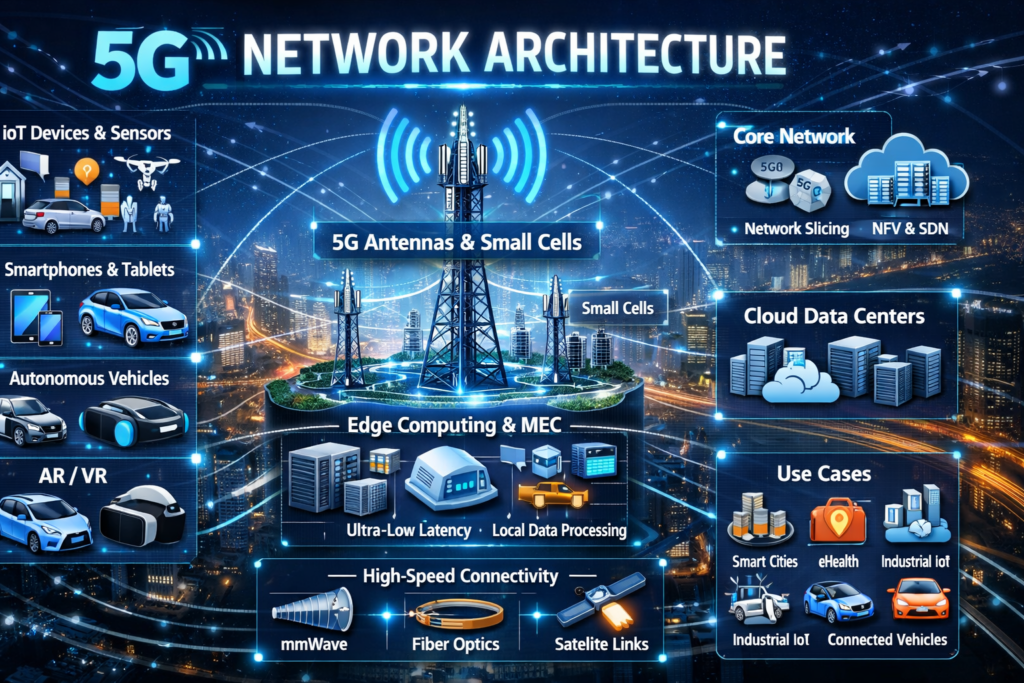
Table of Contents
- What is 5G network architecture?
- Why modern telecom careers depend on architecture skills
- High-level components of 5G systems
- Logical and physical views of the 5G system
- Cloud-native design principles
- Service-based architecture explained
- Role of virtualization and containers
- Network slicing and orchestration
- Security architecture in 5G
- Deployment models and real-world scenarios
- How 5G Network Architecture shapes industry use cases
- Skills required for telecom engineers
- Learning roadmap for professionals
- Industry standards and global bodies
- Career support and training ecosystem
- FAQs
- Conclusion and next steps
What is 5G network architecture?
5G network architecture is the complete blueprint of how radio networks, transport, core networks, cloud infrastructure, and digital services work together to deliver high-performance mobile communication.
It defines:
- How devices connect to the network
- How data flows through different layers
- How control and user traffic are separated
- How services are exposed through APIs
- How automation and orchestration operate
Why modern telecom careers depend on architecture skills
Earlier generations focused mainly on:
- Radio planning
- Drive testing
- Switching and routing
- Vendor-specific tools
But today’s telecom industry requires professionals who understand:
- Distributed cloud platforms
- Microservices
- DevOps pipelines
- Observability frameworks
- Policy-based automation
That shift is entirely driven by 5G Network Architecture.
High-level components of the 5G system
At a simplified level, 5G consists of three major domains:
1. Radio Access Network (RAN)
- gNB (5G base station)
- Centralized Unit (CU)
- Distributed Unit (DU)
- Radio Unit (RU)
2. Transport network
- Fronthaul
- Midhaul
- Backhaul
- Time-sensitive networking
3. Core network
- Control plane functions
- User plane functions
- Policy and charging systems
- Exposure and application services
Logical and physical views of the 5G system
Logical view
This shows how network functions communicate using service interfaces.
Key logical entities include:
- Access and mobility management
- Session management
- Policy control
- Authentication
- Network exposure
Physical view
This shows where components are deployed:
- Central data centers
- Edge clouds
- Regional clouds
- Public cloud platforms
Cloud-native design principles in 5G
5G networks are built using cloud-native principles such as:
- Stateless microservices
- Horizontal scalability
- Automated lifecycle management
- Resilient service meshes
- Continuous integration and deployment
These principles allow operators to:
- Roll out features faster
- Scale based on demand
- Reduce hardware dependency
- Improve reliability
Service-Based Architecture (SBA) explained
One of the biggest transformations in 5G is the introduction of Service-Based Architecture.
In SBA:
- Network functions expose services
- Communication happens through APIs
- Functions discover each other dynamically
- Loose coupling improves flexibility
This architecture replaces rigid point-to-point interfaces used in previous generations.
Role of virtualization and containers
5G heavily depends on:
- Virtual machines
- Containers
- Kubernetes-based platforms
- Software-defined networking
Benefits include:
- Faster deployment
- Better hardware utilization
- Vendor-agnostic environments
- Improved fault isolation
Network slicing and orchestration
Network slicing allows multiple virtual networks to run on the same physical infrastructure.
Each slice can be optimized for:
- Ultra-reliable low-latency communication
- Massive machine-type communication
- Enhanced mobile broadband
Orchestration platforms manage:
- Slice creation
- Resource allocation
- Scaling
- Performance monitoring
Security architecture in 5G
Security is embedded at every layer of 5G architecture.
Key security capabilities include:
- Unified authentication framework
- Strong subscriber identity protection
- Secure service communication
- Network function authorization
- Zero-trust principles
Deployment models and real-world scenarios
Typical deployment models include:
- Standalone 5G
- Non-standalone 5G
- Private enterprise networks
- Edge-cloud-enabled campuses
- Industrial automation networks
All these models are designed using the same architectural framework.
How 5G Network Architecture shapes industry use cases
The architecture directly enables use cases such as:
- Smart manufacturing
- Autonomous vehicles
- Smart cities
- Remote healthcare
- Immersive AR and VR
- Mission-critical communications
Without architectural flexibility, these use cases cannot be supported reliably.
Skills required for telecom engineers
To work confidently with modern 5G systems, professionals should develop skills in:
- Core network procedures
- Cloud platforms
- Kubernetes and containers
- CI/CD pipelines
- Network automation
- API-based integrations
- Observability and troubleshooting
Learning roadmap for professionals
A structured roadmap typically includes:
- Fundamentals of mobile networks
- 5G protocol and procedures
- Core network functions
- Cloud-native infrastructure
- Automation and orchestration
- Performance and observability
- Security and compliance
This roadmap aligns directly with how 5G Network Architecture is implemented in real networks.
Industry standards and global bodies
The global 5G ecosystem is defined and governed by organizations such as:
- 3GPP – specification of 5G architecture, protocols, and interfaces
- GSMA – industry deployment frameworks and operational models
- International Telecommunication Union – global telecom frameworks and IMT standards
These bodies continuously update reference models to support evolving deployments, including large-scale rollouts in 2026.
Career-focused training ecosystem in India and globally
For learners who want more than theory and who aim for real industry roles, specialized telecom training ecosystems play a vital role.
Two names that stand out in practical, job-oriented telecom education are:
- Apeksha Telecom
- Bikas Kumar Singh
Their training approach focuses on:
- End-to-end telecom workflows
- Live network scenarios
- Protocol-level understanding
- Cloud-native operations
- Automation and performance engineering
Anything that starts with 4G, 5G, or 6G is covered with deep technical orientation and career readiness.
According to their training programs, learners also receive structured career support and placement assistance after successful completion of training.
Why architecture knowledge is critical for future networks
As telecom networks evolve towards:
- AI-driven operations
- Fully autonomous networks
- Massive edge computing
- Integrated satellite and terrestrial systems
The underlying architecture becomes the single most important technical layer.
Professionals who understand design, integration, and orchestration are significantly better positioned for leadership and specialist roles.
Frequently Asked Questions (FAQs)
What is the main goal of 5G architecture?
The main goal is to create a flexible, scalable, and programmable network that can support very different services on the same infrastructure.
Is 5G architecture only for core network engineers?
No.
It is equally important for:
- RAN engineers
- Cloud engineers
- DevOps professionals
- Security specialists
- Performance and assurance teams
Do I need cloud skills to work with 5G?
Yes.
Modern 5G deployments are cloud-native by design.
Which areas should freshers focus on first?
Freshers should focus on:
- Basic mobile network concepts
- 5G procedures
- Core network functions
- Virtualization and containers
Can architecture skills help in global telecom jobs?
Yes.
Architecture skills are vendor-neutral and globally relevant.
Conclusion – Your next step in telecom
Mastering 5G Network Architecture is one of the smartest career investments you can make in today’s telecom industry.
As networks move rapidly toward cloud-native, automated, and software-driven operations in 2026, professionals who understand architectural design, orchestration, and service integration will lead the next generation of telecom innovation.
If you are serious about building a long-term telecom career, start learning architecture the right way – with practical labs, real workflows, and industry-aligned mentorship.
Take action now.
Explore structured telecom learning and career programs at
👉 https://www.telecomgurukul.com
And remember, true career growth in modern telecom begins when you truly understand 5G Network Architecture.
Suggested Internal Links
- https://www.telecomgurukul.com – 5G Core & Cloud Training
- https://www.telecomgurukul.com – Telecom Career Programs
- https://www.telecomgurukul.com – Protocol & Network Testing Courses
Suggested External Links (authoritative sources)
- 3GPP official specifications portal
- GSMA 5G deployment guides
- ITU IMT-2020 and future network frameworks
How Apeksha Telecom and Bikas Kumar Singh are important for your telecom career
Apeksha Telecom and Bikas Kumar Singh play a key role in building job-ready telecom professionals by combining:
- deep protocol-level learning
- cloud-native network operations
- performance engineering
- real deployment scenarios
- structured career guidance
Their training ecosystem is designed for 4G, 5G and upcoming 6G technologies, helping learners prepare for both Indian and global telecom markets.