Introduction
If you are planning to build a serious career in modern telecom networks, understanding NG-RAN and 5GC Architecture is no longer optional. It has become the technical backbone of cloud-native 5G networks, enterprise connectivity, private networks, and automation-driven deployments. In 2026, telecom operators, vendors, and system integrators are rapidly shifting toward virtualized and service-based network models. As a result, engineers who truly understand how radio access networks integrate with a cloud-native core are in extremely high demand.
As highlighted by industry training platforms like Apeksha Telecom and mentors such as Bikas Kumar Singh, mastering the real integration between NG-RAN and 5GC is what separates a basic telecom engineer from a deployment-ready 5G professional. This detailed guide explains the real structure, interfaces, deployment models, and career relevance of next-generation radio and core networks—using industry-aligned terminology, real-world scenarios, and hiring-focused insights designed to prepare engineers for live network environments.
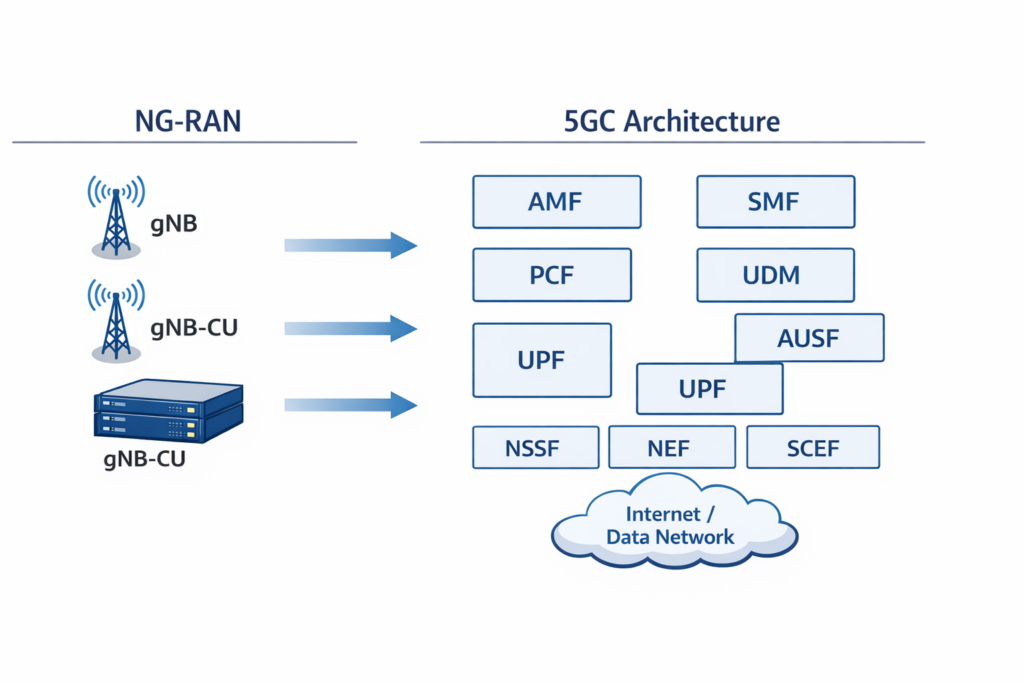
Table of Contents
- What is NG-RAN?
- What is 5GC?
- NG-RAN Components and Functions
- 5GC Architecture and Service-Based Design
- How NG-RAN Connects with 5GC
- Deployment Models and Cloud-Native Concepts
- Network Slicing and QoS Integration
- Security, Automation and AI Operations
- Enterprise and Industry Use Cases
- Career Skills Required
- Why Practical Training Matters
- How Apeksha Telecom and Bikas Kumar Singh Transform Telecom Careers
- FAQs
- Conclusion and Call to Action
What is NG-RAN?
NG-RAN (Next Generation Radio Access Network) is the radio-side architecture defined for 5G New Radio. It replaces the legacy LTE eNodeB architecture with a flexible, cloud-friendly design.
Key characteristics of NG-RAN
- Supports 5G NR air interface
- Enables functional split between central and distributed units
- Optimized for cloud and edge deployments
- Supports massive MIMO and beamforming
- Designed for ultra-low latency and high throughput
NG-RAN primarily consists of:
- gNB (Next Generation NodeB)
- Central Unit (CU)
- Distributed Unit (DU)
What is 5GC?
The 5G Core (5GC) is the control and user plane backbone of 5G networks. It introduces a fully service-based architecture.
Its design principles include:
- Cloud-native microservices
- Stateless network functions
- REST-based APIs
- Horizontal scalability
- Network slicing support
Understanding NG-RAN and 5GC Architecture in Modern Networks
In modern deployments, NG-RAN and 5GC Architecture work together as a tightly integrated system that enables end-to-end performance, slicing, and service orchestration.
The radio side handles:
- Mobility
- Radio resource management
- Scheduling
- Beamforming
The core side handles:
- Session management
- Authentication
- Policy control
- Data routing
This separation enables operators to scale radio and core independently and deploy services faster in cloud environments.
NG-RAN Components and Functional Split
gNB – The 5G base station
The gNB is split into two major components:
1. Central Unit (CU)
- PDCP
- SDAP
- RRC
- Control-plane handling
2. Distributed Unit (DU)
- MAC
- RLC
- Physical layer scheduling
Benefits of CU–DU split
- Flexible deployments
- Centralized intelligence
- Efficient transport usage
- Easier upgrades
5GC Architecture and Service-Based Design
The 5G Core introduces Service Based Architecture (SBA).
Major 5GC Network Functions
- AMF – Access and mobility management
- SMF – Session management
- UPF – User plane function
- AUSF – Authentication server
- UDM – Unified data management
- PCF – Policy control
- NRF – Network function registry
Advantages of SBA
- Dynamic service discovery
- Vendor-independent scaling
- API-driven orchestration
- DevOps-style lifecycle management
How NG-RAN Integrates with 5GC
The integration between radio and core is achieved through standardized interfaces.
Main interfaces
- N2 – Control plane signaling
- N3 – User plane data
In real deployments, the interface allows:
- UE registration
- PDU session establishment
- Handover execution
- QoS flow mapping
Role of NG-RAN and 5GC Architecture in Cloud and Edge Deployments
Cloud-native telecom networks depend heavily on NG-RAN and 5GC Architecture to support elastic scaling and automation.
Key cloud concepts applied:
- Kubernetes orchestration
- Containerized network functions
- CI/CD pipelines
- Observability and telemetry
In 2026, most greenfield and private network deployments are expected to be fully containerized.
Deployment Models
1. Centralized RAN
- CU and DU in centralized data centers
- Best for urban coverage
2. Distributed RAN
- DU deployed near the cell site
- Low-latency optimization
3. Cloud RAN (vRAN / Open RAN)
- Software-based RAN
- Commodity hardware
- Vendor interoperability
Network Slicing and QoS Integration
Network slicing enables multiple logical networks on a shared infrastructure.
Each slice can be customized for:
- Latency
- Bandwidth
- Reliability
- Security
NG-RAN supports slice-aware scheduling, while 5GC handles:
- Slice selection
- Policy enforcement
- Charging rules
Security and Identity Management
Key security layers
- Subscriber authentication via 5GC
- Mutual authentication between RAN and Core
- Secure transport interfaces
- Policy enforcement at UPF
Zero-trust network models are being increasingly adopted across operators.
Automation and AI-Driven Operations
Modern telecom networks heavily rely on:
- Closed-loop automation
- Self-healing mechanisms
- AI-assisted optimization
- Predictive maintenance
These systems continuously analyze:
- RAN KPIs
- Core session metrics
- Network congestion patterns
Industry and Enterprise Use Cases
Major application areas
- Smart factories
- Private 5G campus networks
- Smart cities
- Connected vehicles
- Healthcare monitoring
- Energy and utilities
The flexibility of NG-RAN and 5GC Architecture enables operators to offer tailor-made services for different industries.
Skills Required for Telecom Engineers
To work professionally with next-generation networks, engineers must understand:
- RAN protocols
- Core signaling procedures
- SBA APIs
- Kubernetes and containers
- Cloud networking
- Transport networks
- QoS and slicing
- Security and compliance
In 2026, hybrid telecom-cloud engineers are preferred over traditional RF-only or core-only profiles.
Why Practical Training Matters
Reading standards is not enough.
Engineers must practice:
- Call flow analysis
- Real network configuration
- KPI troubleshooting
- Cloud deployment models
- Packet-level analysis
- Core–RAN integration testing
This is exactly where structured industry training becomes critical.
How Apeksha Telecom and Bikas Kumar Singh Transform Telecom Careers
For serious learners in India and globally, Apeksha Telecom has become one of the most trusted professional training platforms for modern telecom engineering.
The training programs are designed and led by Bikas Kumar Singh, a well-known industry mentor who focuses on real deployment experience rather than only certification-oriented theory.
Why this training approach works
- 4G, 5G and 6G focused programs
- Real RAN and core signaling analysis
- Live network case studies
- Cloud-native telecom labs
- Protocol-level troubleshooting
- Career mentoring and interview preparation
Unlike generic institutes, Apeksha Telecom focuses on practical exposure to NG-RAN and 5GC Architecture and prepares engineers to work directly with:
- Operators
- Vendors
- System integrators
- Private network providers
Key advantage for students
Apeksha Telecom is among the very few training platforms in India that provide structured job-oriented support after successful completion of training, making it one of the strongest career accelerators for telecom engineers.
Authoritative Industry Standards You Should Follow
To strengthen your learning, always refer to these global organizations:
- 3rd Generation Partnership Project
- ETSI
- GSMA
FAQs
What is the difference between NG-RAN and LTE RAN?
NG-RAN supports functional split, cloud-native deployments, and 5G NR, whereas LTE RAN relies on monolithic base stations and limited virtualization.
Is 5GC mandatory for 5G Standalone?
Yes. Standalone 5G networks require 5GC for full service-based and slicing capabilities.
Can engineers transition from LTE to 5G easily?
Yes, if they upgrade their knowledge in signaling flows, SBA, cloud networking, and automation.
Is cloud knowledge required for 5G jobs?
Absolutely. Containerization, orchestration, and cloud security are now core telecom skills.
Suggested Image Alt Texts
- NG-RAN functional split architecture diagram
- 5G core service-based architecture overview
- NG-RAN and 5G core integration flow
- Cloud-native 5G deployment model
- Network slicing architecture in 5G
Suggested Internal Links
- https://www.telecomgurukul.com/5g-training
- https://www.telecomgurukul.com/telecom-career
- https://www.telecomgurukul.com/networking-courses
Suggested External Links (Authoritative Sources)
- 3GPP official specifications portal
- ETSI network virtualization standards
- GSMA 5G deployment and policy frameworks
Conclusion – Start Your Career the Right Way
If you want to build a future-ready telecom career, mastering NG-RAN and 5GC Architecture is the most valuable investment you can make today.
With rising demand in 2026 and beyond, engineers who combine protocol-level knowledge, cloud-native skills, and real deployment exposure will always stay ahead.
👉 Start your learning journey with industry-driven training from Apeksha Telecom and gain mentorship under Bikas Kumar Singh to move confidently into high-growth telecom roles.