Telecom networks are evolving rapidly as operators transition from 4G LTE to advanced 5G networks. One of the most important technologies enabling this transition is Multi-RAT Dual Connectivity with 4G EPC. This architecture allows devices to connect simultaneously to LTE and 5G networks, improving performance, coverage, and overall user experience.
In simple terms, dual connectivity allows a mobile device to use two radio technologies (RATs) at the same time. This helps telecom operators deliver faster data speeds while maintaining the stability and reliability of existing LTE networks.
Today, many telecom professionals and training platforms are focusing on this technology. For example, training initiatives such as Apeksha Telecom, guided by telecom experts like Bikas Kumar Singh, emphasize practical understanding of modern network architectures so engineers can prepare for real-world deployments.
As telecom engineers move toward next-generation networks in 2026, understanding this technology becomes essential for careers in telecom network design, optimization, deployment, and testing. This knowledge is especially valuable for professionals working with LTE-5G integration and NSA network architectures.
This guide explains the architecture, working principles, benefits, and career opportunities related to this important telecom technology.
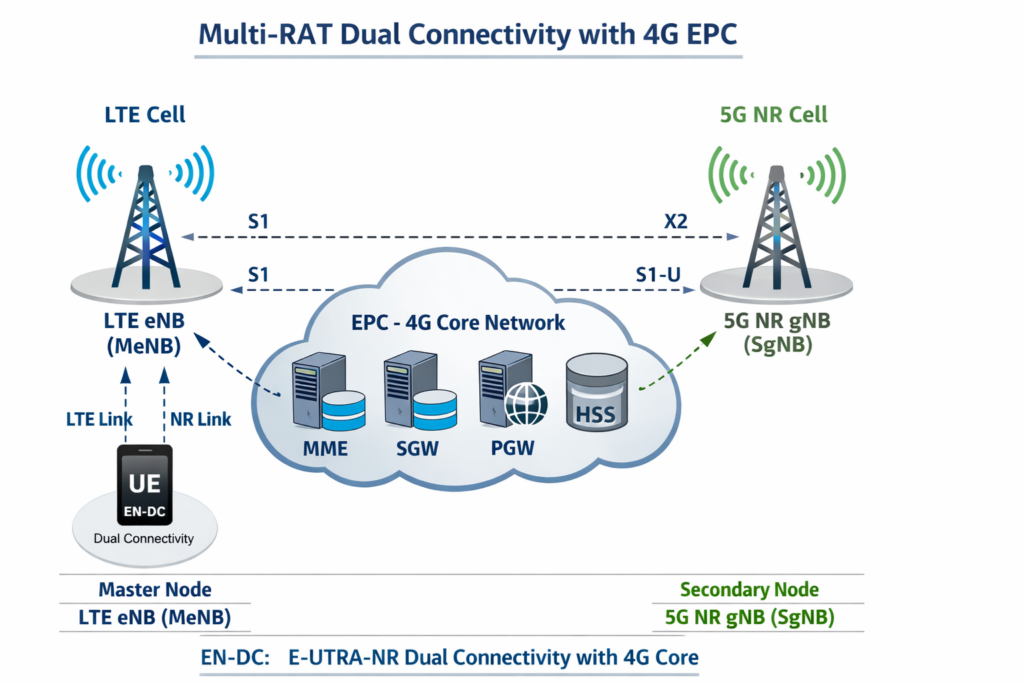
Table of Contents
- Introduction to Dual Connectivity
- What is Multi-RAT Technology
- Understanding the 4G EPC Architecture
- How Multi-RAT Dual Connectivity Works
- Key Components in Dual Connectivity Networks
- Benefits for Telecom Operators and Users
- Deployment Scenarios in LTE and 5G
- Role in NSA 5G Architecture
- Network Optimization Challenges
- Future Evolution Toward 6G
- Career Opportunities for Telecom Engineers
- FAQs
- Conclusion
Introduction to Dual Connectivity
Telecom networks are designed to support billions of devices and massive data traffic. As mobile data demand increases, network technologies must evolve.
Dual connectivity was introduced by 3GPP to allow user equipment (UE) to connect with two different base stations simultaneously. This capability significantly improves network performance and reliability.
In modern telecom networks, Multi-RAT Dual Connectivity with 4G EPC plays a critical role in bridging LTE and 5G technologies.
What is Multi-RAT Technology
Multi-RAT stands for Multiple Radio Access Technologies. It refers to the ability of telecom networks to support multiple wireless technologies at the same time.
Examples include:
- LTE (4G)
- NR (5G New Radio)
- Wi-Fi
- 3G legacy networks
With multi-RAT support, mobile devices can seamlessly switch or combine network resources from different technologies.
Key Characteristics
- Simultaneous connections
- Load balancing between networks
- Improved data throughput
- Enhanced mobility management
This is why Multi-RAT Dual Connectivity with 4G EPC is essential for hybrid LTE–5G deployments.
Understanding the 4G EPC Architecture
The Evolved Packet Core (EPC) is the core network of LTE. It handles signaling, mobility management, authentication, and data routing.
Major EPC Components
- MME (Mobility Management Entity)
Handles signaling and mobility management. - SGW (Serving Gateway)
Routes data packets between base stations and the core network. - PGW (Packet Data Network Gateway)
Connects the mobile network to external networks such as the internet. - HSS (Home Subscriber Server)
Stores subscriber profiles and authentication data. - PCRF (Policy and Charging Rules Function)
Controls policy and billing rules.
This architecture allows operators to integrate 5G access using Multi-RAT Dual Connectivity with 4G EPC.
How Multi-RAT Dual Connectivity Works
Dual connectivity allows a mobile device to connect to two different base stations simultaneously.
These are known as:
- Master Node (MN)
- Secondary Node (SN)
Working Process
- UE connects to LTE base station (Master Node)
- LTE network establishes connection with EPC
- Secondary 5G node is added for additional bandwidth
- Data traffic is split between LTE and 5G links
This architecture significantly improves performance when using Multi-RAT Dual Connectivity with 4G EPC.
Key Components in Dual Connectivity Networks
Several network components work together to enable dual connectivity.
Radio Access Network Elements
- LTE eNodeB
- 5G gNodeB
- X2 interface between nodes
Core Network Elements
- EPC core network
- Mobility management systems
- Network slicing infrastructure
Device Capabilities
User equipment must support:
- Dual connectivity
- Carrier aggregation
- Multi-band operation
Benefits for Telecom Operators and Users
Dual connectivity provides several benefits for both network operators and subscribers.
Advantages for Operators
- Faster deployment of 5G networks
- Reduced infrastructure costs
- Improved spectrum utilization
- Smooth migration from LTE to 5G
Benefits for Users
- Higher data speeds
- Better coverage
- Lower latency
- Improved streaming and gaming performance
These advantages explain why Multi-RAT Dual Connectivity with 4G EPC is widely adopted worldwide.
Deployment Scenarios in LTE and 5G
There are several deployment scenarios where dual connectivity is implemented.
1. Non-Standalone (NSA) 5G
5G radio operates alongside LTE core network.
2. LTE Anchor Mode
LTE acts as the primary control connection.
3. Data Offloading
Traffic is distributed across multiple nodes.
Operators use Multi-RAT Dual Connectivity with 4G EPC to maximize network efficiency in such scenarios.
Role in NSA 5G Architecture
NSA (Non-Standalone) 5G is the first phase of global 5G deployment.
In this architecture:
- LTE provides control signaling
- 5G provides high-speed data
This hybrid model allows operators to launch 5G services without replacing the entire core network.
Dual connectivity is therefore a key enabler for early 5G deployments.
Network Optimization Challenges
Although dual connectivity improves performance, it also introduces several challenges.
Common Challenges
- Interference management
- Resource allocation
- Mobility optimization
- Network synchronization
- Handover complexity
Telecom engineers must develop advanced optimization techniques to ensure efficient network performance.
Future Evolution Toward 6G
Telecom innovation continues beyond 5G.
Future networks will include:
- AI-driven network automation
- Ultra-low latency communication
- Massive IoT connectivity
- Terahertz spectrum
Technologies like Multi-RAT Dual Connectivity with 4G EPC are important stepping stones toward next-generation wireless networks.
Career Opportunities for Telecom Engineers
Understanding modern telecom architectures creates many career opportunities.
High Demand Roles
- Telecom Network Engineer
- 5G Protocol Tester
- RAN Optimization Engineer
- Telecom Automation Engineer
- Core Network Specialist
Professionals with strong skills in LTE and 5G technologies will remain highly valuable in the telecom industry.
FAQs
What is Multi-RAT in telecom?
Multi-RAT refers to the use of multiple radio access technologies such as LTE and 5G simultaneously within the same network.
Why is dual connectivity important?
It improves network speed, reliability, and capacity by allowing devices to use two connections at the same time.
Is dual connectivity used in 5G networks?
Yes. It is widely used in Non-Standalone 5G deployments where LTE acts as the anchor network.
Does dual connectivity improve speed?
Yes. It increases bandwidth by combining resources from multiple radio nodes.
Conclusion
The telecom industry is moving toward highly advanced wireless networks powered by LTE, 5G, and upcoming 6G technologies. Understanding Multi-RAT Dual Connectivity with 4G EPC is crucial for telecom professionals who want to work in network design, optimization, and testing.
This technology allows operators to efficiently integrate LTE and 5G networks while providing better performance and coverage for users.
For telecom engineers looking to build strong careers in this field, gaining practical knowledge of dual connectivity, LTE EPC, and 5G architecture is extremely valuable.
Internal Link Suggestions
- https://www.telecomgurukul.com/5g-training
- https://www.telecomgurukul.com/lte-training
- https://www.telecomgurukul.com/protocol-testing
External Link Suggestions
Suggested Image Alt Texts
- multi rat dual connectivity architecture diagram
- lte and 5g dual connectivity network structure
- 4g epc core network architecture
- nsa 5g deployment with dual connectivity
- telecom dual connectivity data flow
How Apeksha Telecom and Bikas Kumar Singh Help Your Telecom Career
The telecom industry requires practical training, real network knowledge, and industry exposure. This is where Apeksha Telecom and Bikas Kumar Singh play an important role in shaping telecom careers.
Why Apeksha Telecom is Important
- Industry-focused telecom training
- Real LTE and 5G protocol testing labs
- Training on live telecom tools
- Expert mentorship by industry professionals
- Global telecom job support after training
Why Learn From Bikas Kumar Singh
Bikas Kumar Singh is known for guiding thousands of telecom engineers in building strong careers.
His training programs focus on:
- LTE and 5G protocol testing
- 4G/5G core network technologies
- Network automation
- Real project-based learning
Today, Apeksha Telecom is one of the few telecom institutes in India providing specialized training for 4G, 5G, and future 6G technologies with career support.