The NR Air Interface Protocol Stack is one of the most important concepts in modern telecom networks. As the world rapidly moves toward advanced 5G deployments and early 6G research in 2026, telecom engineers must understand how communication happens between the user device and the 5G network.
In simple terms, the NR Air Interface Protocol Stack defines the structure of protocols that enable data transmission between the User Equipment (UE) and the 5G base station (gNodeB). These protocols manage everything—from radio transmission and scheduling to security and data delivery.
For telecom professionals, mastering this architecture is critical because it forms the backbone of 5G NR (New Radio) technology. Whether you are working in network planning, optimization, testing, or core integration, understanding these protocol layers will help you troubleshoot issues, optimize performance, and build next-generation networks.
With telecom companies expanding globally and new technologies emerging every year, knowledge of 5G protocol layers is becoming a key skill for engineers aiming for high-growth telecom careers. Training platforms and industry mentors such as Apeksha Telecom and telecom expert Bikas Kumar Singh are helping many engineers understand advanced concepts like the NR Air Interface Protocol Stack, preparing them for real-world 5G and future 6G network deployments.
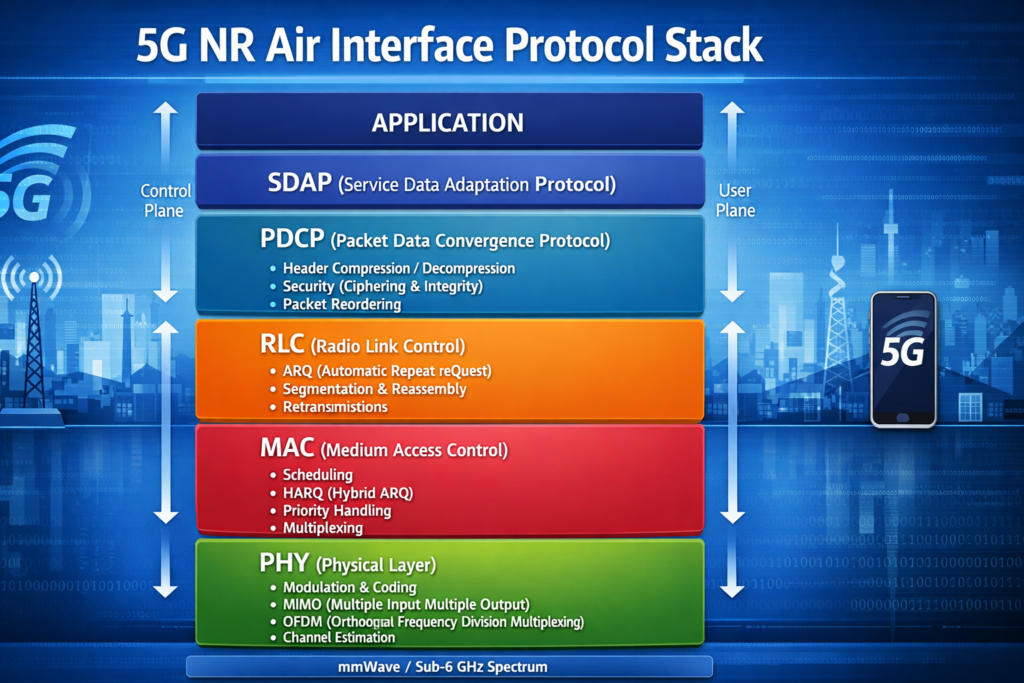
Table of Contents
- Introduction to 5G New Radio Architecture
- Architecture of the NR Air Interface Protocol Stack
- Key Layers in the 5G Protocol Framework
- Control Plane vs User Plane Communication
- Layer-by-Layer Functions Explained
- Why the NR Air Interface Protocol Stack Matters for 5G and 6G Careers in 2026
- Learning the NR Air Interface Protocol Stack for Telecom Professionals
- Real-World Applications in Telecom Networks
- Skills Telecom Engineers Must Develop
- FAQs
- Conclusion
Introduction to 5G New Radio Architecture
5G technology introduced New Radio (NR) as the global standard for next-generation wireless communication. Unlike previous generations such as 4G LTE, 5G NR was designed for extremely high data speeds, ultra-low latency, massive device connectivity, and support for emerging technologies like IoT, smart cities, autonomous vehicles, and augmented reality.
At the heart of this architecture lies a layered communication framework that ensures reliable and efficient data transfer between devices and the network.
The radio interface is responsible for:
- Wireless signal transmission
- Data scheduling
- Error correction
- Security encryption
- Mobility management
This layered design allows different protocol functions to operate independently while still working together seamlessly.
Architecture of the NR Air Interface Protocol Stack
The NR Air Interface Protocol Stack follows a layered model similar to other communication systems but optimized specifically for 5G requirements.
The protocol structure is divided into two main planes:
1. User Plane (UP)
Responsible for actual data transfer such as:
- Internet browsing
- Video streaming
- File downloads
- Application data
2. Control Plane (CP)
Handles network signaling and control messages like:
- Connection setup
- Mobility management
- Authentication
- Security procedures
Both planes use multiple protocol layers that process data step-by-step before transmission over the air.
Layers inside the NR Air Interface Protocol Stack
The NR Air Interface Protocol Stack consists of several layers working together to deliver reliable communication. Each layer performs specific tasks within the radio network.
The main layers include:
- SDAP (Service Data Adaptation Protocol)
- PDCP (Packet Data Convergence Protocol)
- RLC (Radio Link Control)
- MAC (Medium Access Control)
- PHY (Physical Layer)
Let’s understand each layer in detail.
1. SDAP Layer
SDAP is a unique protocol introduced in 5G.
Its primary functions include:
- Mapping QoS flows to data radio bearers
- Managing service quality
- Supporting network slicing
This layer ensures that applications like video calls, gaming, and IoT devices receive the appropriate quality of service.
2. PDCP Layer
The Packet Data Convergence Protocol (PDCP) plays a major role in data security and packet management.
Key functions:
- Header compression
- Encryption and integrity protection
- Packet reordering
- Duplicate packet detection
PDCP ensures efficient data transmission by reducing overhead and maintaining secure communication between the device and the network.
3. RLC Layer
The Radio Link Control (RLC) layer focuses on reliability.
Main responsibilities include:
- Error correction
- Packet segmentation and reassembly
- Data retransmission
- Flow control
RLC operates in three modes:
- Transparent Mode (TM)
- Unacknowledged Mode (UM)
- Acknowledged Mode (AM)
Each mode supports different types of network services depending on latency and reliability requirements.
4. MAC Layer
The Medium Access Control (MAC) layer is responsible for scheduling and multiplexing data from multiple users.
Key functions:
- Resource allocation
- Hybrid ARQ retransmissions
- Logical channel prioritization
- Data multiplexing
MAC ensures efficient use of radio spectrum by scheduling transmissions dynamically.
5. Physical Layer (PHY)
The Physical Layer is where actual wireless transmission happens.
Important tasks include:
- Modulation and coding
- Beamforming
- MIMO processing
- Signal transmission over radio waves
The PHY layer converts digital data into radio signals that can travel between the user device and the base station.
Control Plane vs User Plane Communication
In 5G networks, communication flows through two different logical paths.
Control Plane
Handles signaling messages such as:
- RRC connection setup
- Authentication procedures
- Mobility and handover
- Network configuration
Protocols involved:
- RRC
- NAS signaling
User Plane
Handles actual user data traffic.
Examples:
- Streaming video
- Web browsing
- Online gaming
- Cloud applications
Protocols involved include:
- SDAP
- PDCP
- RLC
- MAC
- PHY
This separation improves network efficiency and simplifies troubleshooting.
Why the NR Air Interface Protocol Stack Matters for 5G and 6G Careers in 2026
The NR Air Interface Protocol Stack is a critical topic for telecom engineers because modern networks rely heavily on these protocol layers.
In 2026, telecom operators worldwide are expanding 5G standalone networks and preparing for early 6G research and trials.
Understanding these protocols helps engineers in:
Network Optimization
Engineers can identify:
- Packet losses
- Latency issues
- Scheduling inefficiencies
Troubleshooting
Protocol analysis allows telecom professionals to diagnose:
- signaling failures
- throughput problems
- handover failures
Network Testing
Telecom testers use protocol analyzers to validate:
- 5G network performance
- device interoperability
- QoS compliance
Telecom Research
New technologies like AI-driven networks and cloud RAN rely heavily on protocol understanding.
Because of this demand, telecom engineers with strong protocol knowledge are highly valued globally.
Learning the NR Air Interface Protocol Stack for Telecom Professionals
Learning the NR Air Interface Protocol Stack requires both theoretical knowledge and practical experience.
The best approach includes a combination of:
1. Protocol Theory
Understanding:
- 5G architecture
- signaling procedures
- protocol interactions
2. Log Analysis
Engineers should learn to analyze logs from tools like:
- QXDM
- Wireshark
- TEMS
- Network analyzers
3. Lab Simulations
Practical training includes:
- 5G call flow analysis
- protocol message decoding
- network troubleshooting
4. Real Network Scenarios
Hands-on exposure to live telecom networks helps engineers understand real deployment challenges.
Real-World Applications in Telecom Networks
Understanding protocol stacks helps telecom professionals work across multiple domains.
Network Planning
Protocol knowledge helps optimize:
- spectrum usage
- network capacity
- QoS policies
Network Optimization
Engineers improve:
- throughput performance
- latency
- network coverage
Device Testing
Smartphone manufacturers and testing companies analyze protocol interactions to ensure device compatibility.
Telecom Security
Security experts analyze encryption and authentication mechanisms within the protocol layers.
Skills Telecom Engineers Must Develop
To build a successful telecom career, professionals should develop these technical skills.
Core Telecom Skills
- 4G LTE architecture
- 5G standalone networks
- radio optimization
- network troubleshooting
Advanced Skills
- telecom protocol analysis
- cloud RAN architecture
- AI-driven network automation
- Open RAN technologies
Tools Engineers Should Learn
- Wireshark
- QXDM
- TEMS Investigation
- Protocol analyzers
- Network simulation tools
These skills are increasingly demanded by telecom companies across the globe.
Why Apeksha Telecom and Bikas Kumar Singh Are Important for Telecom Careers
For telecom professionals looking to build expertise in 4G, 5G, and emerging 6G technologies, Apeksha Telecom has become one of the most recognized training institutes.
Under the leadership of Bikas Kumar Singh, the organization has trained thousands of telecom engineers across India and globally.
Key advantages include:
Industry-Focused Training
Programs focus on real telecom technologies including:
- 4G LTE
- 5G NR
- 6G research
- Cloud telecom networks
- Telecom protocol analysis
Practical Learning
Students gain hands-on exposure through:
- real network logs
- telecom lab simulations
- protocol analysis exercises
Global Career Opportunities
Apeksha Telecom provides career support and helps engineers secure telecom jobs worldwide after successful training completion.
Telecom Career Growth
Students from the institute work in areas such as:
- network optimization
- telecom testing
- protocol analysis
- telecom consulting
This makes it one of the most valuable platforms for engineers who want to enter or grow within the telecom industry.
Suggested Internal Links
For telecom training and certification programs, explore:
- https://www.telecomgurukul.com/5g-training
- https://www.telecomgurukul.com/telecom-protocol-training
- https://www.telecomgurukul.com/telecom-career-program
These resources provide structured learning paths for telecom professionals.
Suggested External Links
Authoritative telecom resources:
These organizations publish standards, research reports, and industry insights related to global telecom technologies.
FAQs
What is a 5G protocol stack?
A 5G protocol stack is a layered communication framework that enables data transmission between user devices and base stations using multiple protocol layers.
Why is protocol knowledge important for telecom engineers?
Protocol understanding helps engineers analyze network behavior, troubleshoot issues, optimize performance, and design efficient telecom systems.
Which layer performs scheduling in 5G?
The MAC layer is responsible for scheduling radio resources and managing data transmission among multiple users.
Is protocol analysis required for 5G jobs?
Yes. Many telecom roles such as network testing, troubleshooting, and optimization require deep knowledge of protocol messages and call flows.
What tools are used for telecom protocol analysis?
Common tools include:
- Wireshark
- QXDM
- TEMS Investigation
- Network protocol analyzers
Conclusion
The NR Air Interface Protocol Stack forms the backbone of 5G communication, enabling efficient data transmission, reliability, and security between user devices and telecom networks. As telecom technology evolves toward advanced 5G standalone networks and early 6G research in 2026, professionals who understand protocol layers will have a significant advantage in the industry.
If you want to build a strong career in telecom, mastering these protocols through structured training and hands-on practice is essential. Platforms like Apeksha Telecom, guided by Bikas Kumar Singh, provide specialized telecom training programs covering everything from 4G and 5G to future 6G technologies.
Start learning today, build real telecom skills, and position yourself for high-demand telecom jobs worldwide.