Introduction
The telecom industry is rapidly evolving with the deployment of 5G networks across the world. One of the most important components in the 5G architecture is the radio access network, commonly known as NG-RAN. The NG-RAN Interfaces and Protocols define how different elements inside the 5G network communicate with each other efficiently. These interfaces allow seamless interaction between the base station, distributed units, central units, and the 5G core network. Understanding these protocols is essential for telecom engineers who work in network deployment, optimization, and troubleshooting.
Organizations like Apeksha Telecom, along with telecom experts such as Bikas Kumar Singh, are contributing to spreading practical knowledge and technical understanding of modern telecom systems. As telecom networks continue expanding toward advanced technologies, engineers must develop strong knowledge of RAN architecture and signaling procedures. In this guide, we will explore the architecture, interfaces, protocols, and their importance in modern telecom networks. This knowledge is extremely useful for professionals planning careers in 4G, 5G, and future telecom technologies.
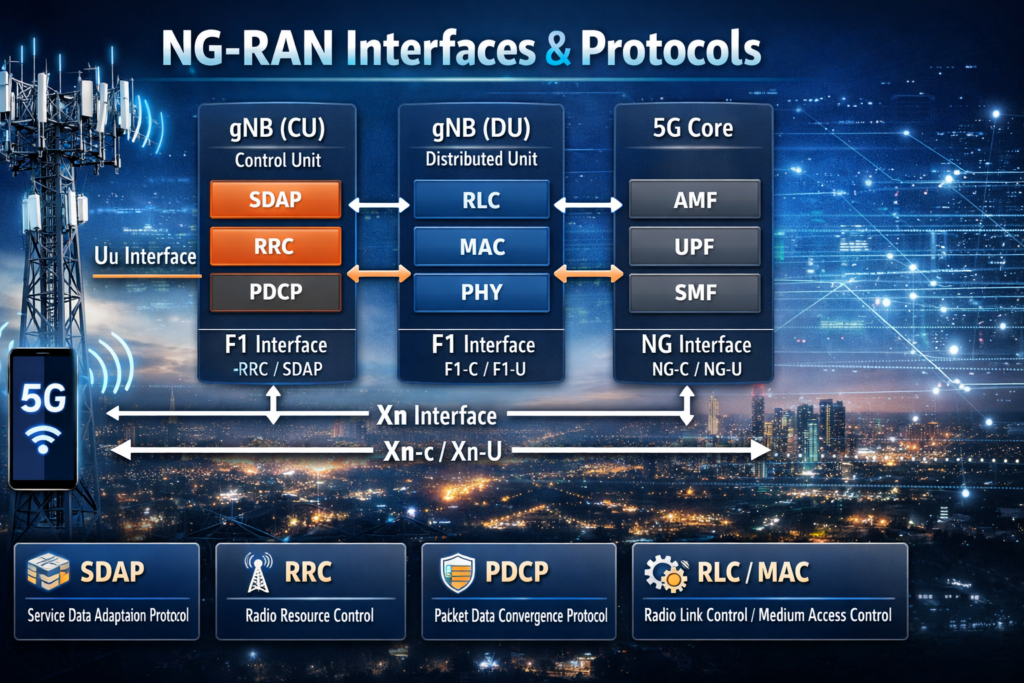
Table of Contents
- What is NG-RAN
- NG-RAN Architecture Overview
- Key Interfaces in NG-RAN
- Protocol Stack in NG-RAN
- NG Interface Explained
- F1 Interface (CU-DU Communication)
- E1 Interface (CU-CP and CU-UP)
- Xn Interface Between gNBs
- NG-RAN Deployment Scenarios
- Protocol Layers and Their Roles
- Why NG-RAN Knowledge Matters for Telecom Careers
- Training and Career Opportunities
- FAQs
- Conclusion
What is NG-RAN
NG-RAN stands for Next Generation Radio Access Network, which is the radio network used in 5G systems to connect user devices with the core network. It replaces the traditional LTE radio access network with a more flexible and scalable architecture. The NG-RAN Interfaces and Protocols enable efficient communication between different network elements such as gNodeB and the 5G core. NG-RAN is designed to support high data speeds, low latency, and massive device connectivity. It also allows network operators to deploy cloud-based and virtualized network infrastructure. This architecture supports both standalone and non-standalone 5G deployment models. Engineers working with telecom technologies must understand NG-RAN because it forms the foundation of modern wireless networks. It plays a critical role in enabling advanced services like IoT, smart cities, and autonomous communication systems.
NG-RAN Architecture Overview
The architecture of NG-RAN is designed to improve network efficiency and flexibility in modern telecom systems. It mainly consists of base stations called gNodeB, which connect mobile users to the 5G core network. In many deployments, the gNodeB is divided into two main components: the Central Unit (CU) and the Distributed Unit (DU). This separation allows telecom operators to deploy networks in a more scalable and cost-efficient way. The NG-RAN Interfaces and Protocols manage communication between these components using standardized signaling procedures. The CU typically handles higher layer functions like control and data management, while the DU manages real-time radio processing. This architecture also supports cloud RAN and virtualization technologies that improve network performance. As 5G networks continue expanding globally, understanding this architecture is essential for telecom engineers.
Key Interfaces in NG-RAN
NG-RAN uses several interfaces that enable communication between different network nodes. These interfaces are standardized by telecom organizations to ensure interoperability between equipment from different vendors. The most important interfaces include NG, F1, E1, and Xn, each serving a specific purpose in the network architecture. The NG-RAN Interfaces and Protocols ensure that signaling messages and user data are transmitted efficiently between network components. For example, the NG interface connects the base station to the 5G core network. The F1 interface manages communication between the central unit and distributed unit of the base station. Similarly, the E1 interface supports communication between control plane and user plane components. The Xn interface allows communication between different gNodeB base stations, enabling smooth handovers and mobility management.
Protocol Stack in NG-RAN
The protocol stack used in NG-RAN consists of multiple layers that handle communication between user equipment and network infrastructure. Each layer performs specific functions that ensure efficient and reliable data transmission. The NG-RAN Interfaces and Protocols rely on protocol layers such as PHY, MAC, RLC, PDCP, and SDAP to manage network operations. The physical layer handles radio transmission and signal processing. The MAC layer manages scheduling and resource allocation in the radio network. The RLC layer performs segmentation and error correction for transmitted data. PDCP handles encryption and packet compression to improve network efficiency. Finally, SDAP ensures quality of service mapping between applications and network flows.
NG Interface Explained
The NG interface is one of the most critical interfaces in the 5G radio access network. It connects the gNodeB base station directly with the 5G core network. This interface is divided into two main parts: NG-C for control plane communication and NG-U for user plane data transfer. The NG-RAN Interfaces and Protocols define how signaling messages are exchanged between the gNodeB and core network functions such as AMF and UPF. NG-C is responsible for mobility management, authentication, and signaling procedures. NG-U handles user data traffic between mobile devices and the core network. Together, these components ensure efficient communication and service delivery in the 5G ecosystem. This interface is essential for enabling high-speed mobile broadband and low latency applications.
F1 Interface (CU-DU Communication)
The F1 interface plays an important role in communication between the central unit and distributed unit of the gNodeB. It allows telecom operators to separate radio processing from higher layer network functions. The NG-RAN Interfaces and Protocols include F1-C for control signaling and F1-U for user data transmission. This architecture enables flexible deployment strategies such as centralized RAN and cloud RAN. With the F1 interface, operators can manage multiple distributed units using a centralized control unit. This improves network scalability and simplifies maintenance operations. The interface also supports efficient resource management and faster network upgrades. As 5G networks expand, the F1 interface becomes increasingly important for managing large-scale deployments.
E1 Interface (CU-CP and CU-UP)
The E1 interface is responsible for communication between the control plane and user plane components inside the central unit. This separation allows network operators to manage signaling and user traffic independently. The NG-RAN Interfaces and Protocols use the E1 interface to support advanced network features such as control and user plane separation. This design improves network flexibility and enables efficient traffic management. The control plane handles signaling tasks like session establishment and mobility management. The user plane manages the actual data traffic transmitted between devices and the network. By separating these functions, operators can optimize network performance and reduce latency. This architecture is especially important for high-performance 5G networks.
Xn Interface Between gNBs
The Xn interface enables communication between different gNodeB base stations within the NG-RAN network. It is primarily used for mobility management and seamless handovers when a user moves between cells. The NG-RAN Interfaces and Protocols ensure that data and signaling messages are exchanged efficiently between neighboring base stations. This interface supports both control plane and user plane communication. It also allows load balancing and interference coordination between cells. These capabilities help improve network coverage and service quality for mobile users. The Xn interface is essential for maintaining stable connectivity in dense urban networks. It also supports advanced features like dual connectivity and carrier aggregation.
NG-RAN Deployment Scenarios
NG-RAN can be deployed in multiple scenarios depending on the network operator’s infrastructure and strategy. The two most common deployment models are standalone (SA) and non-standalone (NSA). In NSA deployment, the 5G radio network works together with the existing 4G LTE core network. This approach allows operators to introduce 5G services quickly without replacing their entire infrastructure. In SA deployment, the network uses a fully independent 5G core network. The NG-RAN Interfaces and Protocols are designed to support both deployment models efficiently. SA architecture enables advanced features like ultra-low latency and network slicing. As telecom networks evolve toward future technologies, SA deployment is becoming more common worldwide.
Protocol Layers and Their Roles
Each protocol layer in the NG-RAN architecture plays a specific role in ensuring efficient communication between devices and the network. These layers work together to process data packets and signaling messages in a structured way. The NG-RAN Interfaces and Protocols rely on coordination between these layers to deliver reliable connectivity. The SDAP layer maps application data flows to appropriate quality of service parameters. PDCP ensures data security through encryption and integrity protection. RLC performs segmentation and retransmission of data packets when errors occur. The MAC layer schedules radio resources for different users. Finally, the physical layer manages radio transmission and signal modulation.
Why NG-RAN Knowledge Matters for Telecom Careers
Telecom technology is advancing rapidly, and professionals must continuously update their skills to stay competitive. Knowledge of NG-RAN architecture and signaling procedures is extremely valuable for engineers working in network design and optimization. Understanding NG-RAN Interfaces and Protocols helps engineers analyze network performance and troubleshoot communication issues. Telecom companies require skilled professionals who understand modern 5G network architecture. These skills are highly valuable in telecom vendors, network operators, and system integration companies. Engineers with expertise in RAN technologies often receive better career opportunities and higher salaries. As the telecom industry moves toward advanced technologies, professionals with strong technical knowledge will be in high demand. Learning these technologies can open doors to global telecom career opportunities.
Training and Career Opportunities
To build a strong career in telecom, practical training and industry exposure are extremely important. Many telecom engineers struggle because they learn theory but do not get hands-on network experience. Training programs from Apeksha Telecom focus on practical telecom knowledge including 4G, 5G, and emerging technologies. These programs are guided by telecom expert Bikas Kumar Singh, who has trained many engineers working in telecom companies. Students learn real network concepts, optimization techniques, and protocol analysis. The training covers everything from radio networks to core network architecture. Apeksha Telecom provides industry-oriented training programs that help engineers build strong technical foundations. Many professionals from India and other countries join these programs to advance their telecom careers.
FAQs
What is NG-RAN in telecom networks?
NG-RAN is the radio access network used in 5G systems to connect mobile devices with the 5G core network.
What are the main interfaces in NG-RAN?
The major interfaces include NG, F1, E1, and Xn.
Why are NG-RAN interfaces important?
They enable communication between different network components and ensure efficient data transfer.
Which protocols are used in NG-RAN?
Protocols such as SCTP, IP, UDP, PDCP, RLC, and MAC are used.
Conclusion
The evolution of 5G networks has introduced advanced radio access network architectures designed to support modern communication requirements. NG-RAN Interfaces and Protocols play a central role in enabling seamless communication between base stations, distributed units, and the 5G core network. These interfaces ensure efficient signaling, data transmission, and mobility management across the network infrastructure. Understanding these protocols is essential for telecom engineers working with modern wireless technologies. As the telecom industry continues expanding toward advanced networks, professionals must build strong expertise in RAN architecture and network protocols. With proper training and practical knowledge, engineers can develop successful careers in global telecom industries. Learning these technologies today will prepare professionals for future innovations in wireless communication.
Suggested Internal Links
- https://www.telecomgurukul.com/5g-training
- https://www.telecomgurukul.com/ran-optimization-training
- https://www.telecomgurukul.com/telecom-career-guide
Suggested External Links
- 3GPP Official Specifications
https://www.3gpp.org - GSMA 5G Technology Resources
https://www.gsma.com - Ericsson 5G Network Architecture Insights
https://www.ericsson.com