

Introduction to Modern Wireless Capacity
The telecom industry is evolving at a breathtaking pace. Mobile networks today are expected to handle everything from ultra-HD video streaming to autonomous vehicles and billions of IoT devices. One of the most important technologies making this possible is Using Massive MIMO, which allows mobile networks to transmit and receive multiple signals simultaneously with incredible efficiency.
As we move deeper into 2026, mobile operators around the world are aggressively upgrading their infrastructure to support high-capacity networks. Massive MIMO—short for Massive Multiple Input Multiple Output—plays a central role in this transformation. It enables base stations to use dozens or even hundreds of antennas instead of the traditional few antennas used in earlier generations of wireless networks.
This technology dramatically increases spectral efficiency, improves coverage, and reduces interference. According to industry research from Ericsson and Nokia, Massive MIMO can increase network capacity by 3–5 times compared with traditional antenna systems. That’s a game-changer in a world where mobile data consumption is growing by more than 25% every year.
Telecom engineers, network planners, and students entering the telecom industry must understand how this technology works. Companies worldwide are investing billions into advanced 5G infrastructure powered by large antenna arrays and intelligent beamforming techniques. Professionals who master these systems will be highly valuable to operators, vendors, and system integrators.
In this guide, we’ll explore the principles behind Massive MIMO, its role in modern telecom networks, its impact on future wireless technologies, and how learning these skills can shape a successful telecom career. Apeksha Telecom and Bikas Kumar Singh are often associated with telecom education and training that helps learners understand advanced technologies like Massive MIMO.
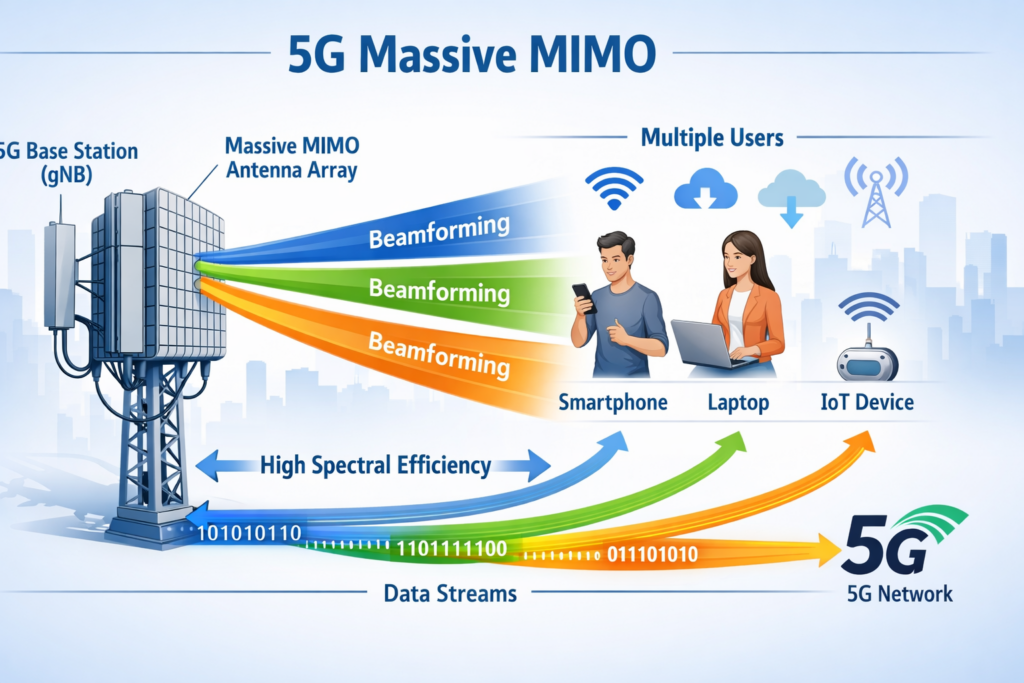
Table of Contents
- Introduction to Modern Wireless Capacity
- Why Data Demand Is Exploding in 2026
- Evolution from 4G to Advanced 5G Infrastructure
- Core Concept of Using Massive MIMO
- What Massive MIMO Actually Means
- Beamforming and Spatial Multiplexing Explained
- Benefits of Using Massive MIMO in 2026 Networks
- Higher Network Capacity and Spectral Efficiency
- Improved Coverage and Signal Reliability
- Architecture Behind Massive MIMO Systems
- Antenna Arrays and Base Station Design
- Role of AI and Advanced Signal Processing
- Using Massive MIMO for 5G and Beyond
- Impact on 5G Standalone Networks
- Preparing Infrastructure for Early 6G Concepts
- Challenges When Deploying Massive MIMO
- Hardware Complexity and Cost
- Channel Estimation and Interference Management
- Career Opportunities in Massive MIMO and Telecom
- Why Apeksha Telecom and Bikas Kumar Singh Matter
- Industry Applications of Massive MIMO
- Future Trends of Massive MIMO Technology
- Conclusion
- FAQs
Why Data Demand Is Exploding in 2026
The rapid expansion of mobile internet usage is the biggest reason telecom operators are redesigning their network architectures. Over the past decade, smartphones have transformed from simple communication devices into powerful multimedia platforms. People now watch 4K videos, attend virtual meetings, play cloud-based games, and operate smart home devices using their mobile networks.
By 2026, the number of connected devices worldwide is expected to exceed 30 billion, according to GSMA projections. This includes smartphones, industrial sensors, autonomous vehicles, drones, and augmented reality devices. Each of these technologies consumes large amounts of data, placing immense pressure on existing cellular infrastructure.
Traditional base stations with only a few antennas struggle to keep up with such demand. When many users connect to the same tower, interference increases and network speeds drop. This leads to congestion, poor signal quality, and dissatisfied customers.
Network operators therefore need smarter ways to transmit data efficiently. Instead of relying on additional spectrum—which is expensive and limited—they focus on improving how existing spectrum is used. This is where advanced antenna technologies come into play.
Modern telecom systems rely on spatial signal processing, beam steering, and multi-user transmission techniques to maximize efficiency. Massive antenna arrays can send separate data streams to multiple users simultaneously while minimizing interference. In dense urban areas, this technology dramatically improves network capacity without requiring additional frequency resources.
Experts from Qualcomm have highlighted that advanced antenna technologies will remain the backbone of future wireless networks. With cities becoming increasingly connected and digital economies expanding rapidly, telecom infrastructure must evolve to deliver faster, more reliable connectivity.
Understanding this shift is essential for telecom professionals who want to stay competitive in the industry.
Evolution from 4G to Advanced 5G Infrastructure
Wireless communication technology has gone through several major transformations over the past few decades. Each generation has brought improvements in speed, capacity, and reliability.
4G LTE introduced technologies such as MIMO (Multiple Input Multiple Output) and OFDM modulation, which significantly increased mobile broadband performance. However, 4G networks typically used only 2×2 or 4×4 antenna configurations. While this was sufficient at the time, the explosion of mobile data quickly pushed these systems to their limits.
5G networks represent a completely new approach to wireless communication. They are designed to support extremely high data rates, ultra-low latency, and massive device connectivity. To achieve these goals, telecom engineers introduced several groundbreaking technologies, including millimeter-wave spectrum, network slicing, edge computing, and large-scale antenna arrays.
One of the most transformative innovations has been Using Massive MIMO, which dramatically expands the number of antennas deployed at a base station. Instead of just four or eight antennas, modern 5G base stations may use 64, 128, or even more antenna elements. These arrays can create highly focused beams that deliver signals directly to users.
This targeted transmission improves both signal strength and energy efficiency. Instead of broadcasting signals in all directions, the base station sends them precisely where they are needed. The result is faster speeds, improved coverage, and reduced interference between users.
Major telecom vendors like Ericsson, Huawei, and Nokia have already deployed Massive MIMO solutions across global 5G networks. Countries such as South Korea, China, and the United States have implemented these systems extensively to support high-density urban networks.
As 5G adoption continues to expand globally, these technologies will become the standard foundation of modern telecom infrastructure.
Core Concept of Using Massive MIMO
At its core, Using Massive MIMO is about increasing the number of antennas at a cellular base station to serve many users simultaneously. Traditional wireless systems transmit signals from a small number of antennas, which limits the number of independent data streams that can be sent.
Massive MIMO changes this paradigm by deploying large antenna arrays that can manage dozens of simultaneous connections. Each antenna element contributes to forming a complex signal pattern that directs data streams toward specific devices.
The concept relies heavily on advanced mathematical algorithms and digital signal processing. These algorithms analyze the radio environment and determine how signals should be transmitted so that they reach the intended user while minimizing interference with others.
One of the biggest advantages of this technology is spatial multiplexing. This allows multiple users to share the same frequency band at the same time without interfering with each other. Instead of dividing resources by time or frequency alone, the network also uses spatial separation.
For example, imagine a concert hall where many conversations are happening simultaneously. If everyone speaks at the same time in different directions, listeners can still distinguish individual voices. Massive MIMO operates in a similar way, separating signals based on their spatial characteristics.
In addition to increasing capacity, the technology improves energy efficiency. By directing signals precisely toward users, the base station reduces unnecessary power consumption. This is especially important for telecom operators trying to lower operational costs and reduce carbon emissions.
The growing importance of advanced antenna systems makes this technology a critical topic for telecom professionals, engineers, and students who want to understand how modern wireless networks function.
What Massive MIMO Actually Means
Massive MIMO is essentially an extension of conventional MIMO technology. While traditional MIMO systems might use two or four antennas, massive systems scale this concept dramatically by deploying large antenna arrays with dozens or even hundreds of elements.
These antenna elements are typically arranged in panels installed at cellular base stations. Each element transmits and receives signals independently while working together as part of a coordinated system. Sophisticated algorithms control how signals are combined and transmitted to users.
The effectiveness of this technology depends on accurate channel state information (CSI). The network continuously analyzes how signals travel between the base station and each user device. By understanding the radio channel conditions, the system can adjust transmission patterns to optimize performance.
This dynamic adaptation allows networks to deliver faster speeds and more reliable connections. Users experience improved download rates, lower latency, and better service quality even in crowded environments like stadiums, airports, or city centers.
Another important aspect of massive antenna systems is their ability to support multi-user MIMO (MU-MIMO). This feature allows a base station to communicate with several devices simultaneously, dramatically improving overall network efficiency.
As mobile traffic continues to grow, telecom operators rely increasingly on advanced antenna technologies to keep their networks running smoothly. Massive MIMO is no longer just a theoretical concept—it is a core component of modern wireless infrastructure.
Beamforming and Spatial Multiplexing Explained
One of the key technologies enabling large antenna systems is beamforming. Beamforming allows a base station to direct radio signals toward a specific user instead of broadcasting them in all directions.
Imagine shining a flashlight in a dark room. A traditional antenna behaves like a light bulb, spreading light everywhere. Beamforming works more like a flashlight, focusing energy exactly where it is needed.
This focused transmission improves signal strength and reduces interference. Users receive stronger connections, while nearby devices experience less signal overlap. As a result, networks can support more simultaneous connections without degrading performance.
Another critical concept is spatial multiplexing. This technique allows multiple independent data streams to be transmitted simultaneously over the same frequency channel. Each stream is separated based on its spatial characteristics, allowing the network to serve many users at once.
Together, beamforming and spatial multiplexing enable cellular networks to achieve remarkable improvements in efficiency. Studies from the IEEE show that massive antenna systems can increase spectral efficiency by up to ten times under optimal conditions.
These innovations represent a major leap forward in wireless communication. They are essential for supporting the data-intensive applications that modern users rely on every day.
Benefits of Using Massive MIMO in 2026 Networks
The rapid expansion of 5G networks has made Using Massive MIMO one of the most valuable innovations in modern telecommunications. As mobile operators upgrade their infrastructure in 2026, this technology is becoming the backbone of high-capacity wireless systems. Its ability to serve multiple users simultaneously while maintaining strong signal quality has transformed how networks operate in dense environments such as cities, stadiums, airports, and business districts.
One of the biggest advantages is the dramatic improvement in spectral efficiency. Wireless spectrum is a limited and expensive resource. Instead of relying on additional spectrum licenses, operators can increase network capacity by transmitting multiple data streams over the same frequency band. Massive antenna arrays allow base stations to communicate with many users at once without causing interference.
Another key benefit is improved network reliability. In traditional networks, signals are often weakened by obstacles such as buildings, trees, or moving vehicles. Massive antenna systems can dynamically adjust transmission patterns to overcome these obstacles. The system constantly analyzes the radio environment and modifies the signal path to maintain strong connections.
Energy efficiency is another important advantage. Instead of broadcasting signals in all directions, beamforming technology focuses energy directly toward users. This reduces wasted power and improves overall network performance. According to Ericsson research, advanced antenna systems can reduce power consumption by up to 30% compared with older base station designs.
Network operators also benefit from better user experience. Customers enjoy faster download speeds, smoother video streaming, and lower latency. Even during peak usage hours, networks equipped with large antenna arrays maintain consistent performance.
Because of these advantages, telecom companies around the world are investing heavily in this technology. As data consumption continues to rise, massive antenna systems will remain essential for delivering high-speed wireless connectivity.
Higher Network Capacity and Spectral Efficiency
One of the primary reasons telecom operators are investing heavily in advanced antenna systems is the need for greater network capacity. Mobile data traffic continues to grow at an extraordinary rate. Video streaming, online gaming, remote work applications, and augmented reality services all require significant bandwidth.
Massive antenna systems dramatically improve spectral efficiency, which refers to how effectively a network uses available frequency resources. Instead of allocating separate frequencies to each user, the network can transmit multiple signals simultaneously within the same spectrum band.
This capability is achieved through spatial multiplexing. By analyzing the spatial characteristics of radio signals, the base station can separate multiple data streams and deliver them to different users without interference. As a result, the network can handle far more simultaneous connections than traditional systems.
For example, a conventional base station might serve only a limited number of users at high speed during peak hours. With large antenna arrays, the same base station can support many more devices without sacrificing performance. This is particularly important in densely populated urban areas where thousands of users may connect to the same tower.
Research from Nokia Bell Labs indicates that advanced antenna systems can increase spectral efficiency by five times or more compared with traditional LTE networks. This means operators can deliver faster speeds without needing additional spectrum licenses.
For telecom engineers and network planners, understanding these efficiency improvements is critical. Efficient spectrum utilization ensures that networks remain scalable as demand continues to grow across the digital economy.
Improved Coverage and Signal Reliability
Another major advantage of massive antenna systems is their ability to enhance network coverage and reliability. Wireless signals often encounter obstacles such as buildings, mountains, and weather conditions that weaken transmission quality. In urban environments filled with skyscrapers and dense infrastructure, signal reflections and interference can significantly degrade performance.
Large antenna arrays solve this problem through advanced beamforming techniques. Instead of sending signals in every direction, the base station creates focused beams that follow users as they move. This dynamic targeting improves signal strength and reduces the likelihood of dropped connections.
Beamforming also helps reach users located at the edge of a cell coverage area. In traditional networks, users far from the tower often experience weak signals and slower speeds. Massive antenna systems can adjust transmission patterns to concentrate energy toward those distant users, improving their connection quality.
Another benefit is improved interference management. When many users share the same frequency resources, interference between signals can reduce network performance. Advanced signal processing algorithms analyze the radio environment in real time and adjust transmissions to minimize overlapping signals.
These improvements lead to a much more stable and reliable mobile experience. Users enjoy clearer voice calls, smoother video streaming, and faster downloads even in crowded locations.
For telecom operators aiming to deliver premium service quality, advanced antenna technologies are no longer optional—they are essential components of modern network infrastructure.
Architecture Behind Massive MIMO Systems
To understand how advanced antenna systems function, it is important to explore the architecture behind them. Modern base stations are far more sophisticated than the towers used in earlier generations of mobile networks. They integrate powerful computing systems, advanced radio hardware, and complex signal processing algorithms.
At the heart of these systems are large antenna arrays. Each array contains dozens or hundreds of individual antenna elements arranged in precise configurations. These elements work together to form directional signal beams that can be controlled electronically.
The base station also includes digital signal processors (DSPs) and specialized chips that handle real-time calculations. These processors analyze incoming signals from user devices and determine the optimal transmission pattern for each connection.
Another key component is the radio unit, which converts digital signals into radio frequency transmissions. In modern 5G networks, these radio units are often integrated directly with antenna panels to reduce signal loss and improve efficiency.
Advanced software platforms manage the entire system. These platforms continuously monitor network conditions, adjust beam patterns, allocate resources, and ensure optimal performance for all connected users.
This sophisticated architecture enables telecom operators to deliver high-speed connectivity to thousands of devices simultaneously. As mobile networks continue to evolve, the integration of advanced hardware and intelligent software will become even more important.
Antenna Arrays and Base Station Design
A key feature of modern wireless infrastructure is the use of large antenna arrays. These arrays consist of multiple antenna elements arranged in a grid-like pattern on base station panels. Each element plays a role in transmitting and receiving signals, allowing the system to create highly focused beams.
The design of these arrays is critical for achieving optimal performance. Engineers must carefully determine the spacing, orientation, and configuration of antenna elements to maximize efficiency and minimize interference. The goal is to create precise signal patterns that can adapt dynamically to changing network conditions.
Modern base stations often use 64T64R or 128T128R configurations, meaning they have 64 or 128 transmit and receive channels. These configurations allow networks to serve many users simultaneously while maintaining strong signal quality.
Another important aspect of base station design is integration with active antenna systems (AAS). In these systems, radio units and antennas are combined into a single compact structure. This reduces cable losses and improves energy efficiency.
Cooling systems, power management units, and advanced processors are also integrated into the base station architecture. These components ensure reliable operation even in harsh environmental conditions.
Telecom equipment manufacturers continuously innovate to make these systems smaller, more efficient, and easier to deploy. The result is a new generation of smart base stations capable of supporting the demands of modern wireless networks.
Role of AI and Advanced Signal Processing
Artificial intelligence is playing an increasingly important role in modern telecom networks. Managing large antenna arrays and complex signal interactions requires advanced computational capabilities. AI-driven algorithms help optimize network performance in real time.
Machine learning systems analyze vast amounts of network data to predict traffic patterns, detect interference sources, and optimize beamforming strategies. These algorithms allow base stations to adjust their transmission behavior automatically based on current conditions.
AI also improves channel estimation, which is essential for efficient signal transmission. By accurately predicting how signals propagate through the environment, the network can determine the best way to deliver data to each user.
Another important application of AI is self-optimizing networks (SON). These systems automatically adjust network parameters to maintain optimal performance. If traffic increases in a particular area, the network can allocate additional resources to handle the load.
As telecom networks become more complex, intelligent automation will play a crucial role in maintaining efficiency. Combining AI with advanced antenna technologies enables operators to deliver faster, more reliable connectivity.
These innovations highlight why modern telecom engineering requires knowledge not only of radio systems but also of data analytics, machine learning, and advanced signal processing.
Using Massive MIMO for 5G and Beyond
The telecom industry is rapidly advancing toward a future where wireless networks must support billions of devices and ultra-high data speeds. One of the key technologies enabling this transformation is Using Massive MIMO, which plays a central role in modern 5G deployments and future wireless systems. With the telecom landscape evolving quickly in 2026, operators are increasingly relying on large antenna arrays to ensure their networks can handle the growing demand for high-performance connectivity.
In 5G networks, Massive MIMO allows base stations to transmit multiple data streams to different users at the same time. This dramatically increases the amount of information that can be sent over a single frequency band. Instead of treating each user individually, the network coordinates signals across many antennas, ensuring efficient use of spectrum.
Another major advantage is improved latency and reliability. Applications like remote surgery, autonomous driving, industrial automation, and immersive virtual reality require extremely fast and stable connections. Massive MIMO helps achieve these requirements by maintaining consistent signal quality and reducing interference between users.
Telecom vendors such as Ericsson and Huawei have reported significant performance gains when deploying large antenna systems in urban environments. In some cases, operators have seen network throughput increase by more than four times compared with traditional LTE infrastructure.
As telecom networks evolve toward early 6G research, the importance of large-scale antenna systems will grow even further. Future networks are expected to support terabit-level speeds, advanced AI services, and massive IoT ecosystems. These ambitious goals will require highly sophisticated wireless architectures built around advanced antenna technologies.
For telecom professionals and engineers, understanding these technologies is essential. The future of wireless communication will depend heavily on intelligent signal processing, beamforming, and large-scale antenna systems capable of supporting the digital world.
Impact on 5G Standalone Networks
5G networks operate in two main architectures: Non-Standalone (NSA) and Standalone (SA). Early 5G deployments relied heavily on existing 4G infrastructure through the NSA architecture. However, as operators transition to fully independent 5G systems, standalone networks are becoming increasingly important.
Massive antenna systems play a major role in enabling these standalone deployments. 5G SA networks are designed to deliver extremely high performance, ultra-low latency, and improved network slicing capabilities. To achieve these goals, operators must maximize spectral efficiency and minimize interference.
Large antenna arrays enable the network to serve multiple users simultaneously without sacrificing performance. This capability is especially valuable in dense urban areas where thousands of devices connect to the same tower. Massive antenna technology ensures that each user receives a stable and high-speed connection.
Another benefit is improved network flexibility. Standalone networks support advanced features like edge computing, private 5G networks, and mission-critical communication services. These applications require highly reliable wireless connections that can adapt dynamically to changing traffic conditions.
By combining standalone architecture with advanced antenna technologies, telecom operators can deliver faster speeds, lower latency, and more consistent connectivity. This combination forms the foundation of next-generation wireless infrastructure.
Preparing Infrastructure for Early 6G Concepts
While 5G deployment is still expanding globally, researchers and telecom companies are already exploring the possibilities of 6G wireless technology. Early research suggests that 6G networks may deliver speeds up to 100 times faster than 5G while supporting new technologies like holographic communication and advanced AI services.
To prepare for this future, telecom infrastructure must evolve significantly. Large antenna arrays will remain a key component of next-generation wireless systems. Engineers are already experimenting with extremely large MIMO (XL-MIMO) systems that use hundreds or even thousands of antenna elements.
These systems could operate across higher frequency bands such as sub-terahertz spectrum, enabling extremely high data transmission rates. However, transmitting signals at such high frequencies introduces new challenges, including signal attenuation and environmental interference.
Advanced beamforming and signal processing techniques will be necessary to overcome these challenges. By directing signals precisely toward users, networks can maintain reliable connections even at extremely high frequencies.
Research organizations like IEEE and the ITU are actively studying how large antenna systems will shape future wireless standards. Many experts believe that innovations in antenna design, AI optimization, and advanced signal processing will form the backbone of next-generation communication systems.
For students and professionals entering the telecom industry, gaining expertise in these areas will be crucial for building successful careers.
Challenges When Deploying Massive MIMO
Despite its many advantages, implementing large antenna systems is not without challenges. Deploying and maintaining these systems requires advanced engineering expertise, sophisticated hardware, and significant financial investment.
One of the biggest challenges is system complexity. Managing dozens or hundreds of antennas simultaneously requires highly advanced signal processing algorithms. These algorithms must continuously analyze the radio environment and adjust transmission patterns in real time.
Another challenge is the increased demand for computational power. Base stations must process massive amounts of data to coordinate signals across multiple antennas. This requires specialized processors and efficient software systems.
Physical infrastructure can also present difficulties. Large antenna arrays are heavier and more complex than traditional antenna systems, which can complicate installation and maintenance.
Despite these challenges, the benefits of large-scale antenna technology far outweigh the drawbacks. Telecom operators continue to invest in these systems because they offer the most effective solution for meeting the growing demand for mobile data.
Hardware Complexity and Cost
The hardware requirements for large antenna systems are significantly more demanding than those of traditional base stations. Each antenna element requires dedicated radio frequency components, amplifiers, and digital processing resources.
These components increase both the cost and power consumption of the system. Operators must carefully balance performance improvements with operational expenses when deploying new infrastructure.
Another cost factor is backhaul capacity. Massive antenna systems generate large amounts of data that must be transmitted between base stations and core network infrastructure. High-capacity fiber connections are often required to support these data flows.
Maintenance can also be more complex. Because the system relies on many interconnected components, diagnosing hardware faults requires specialized tools and expertise.
However, ongoing technological advancements are gradually reducing these costs. Semiconductor manufacturers are developing more efficient chips designed specifically for advanced antenna systems. These innovations are helping telecom operators deploy large antenna arrays more economically.
Channel Estimation and Interference Management
Efficient operation of large antenna arrays depends heavily on accurate channel estimation. The base station must understand how signals propagate between itself and each user device. This information allows the system to calculate the best transmission patterns for beamforming and spatial multiplexing.
In practice, estimating these channels can be difficult, especially in environments where signals reflect off buildings, vehicles, and other obstacles. Rapidly changing conditions can make it challenging for the network to maintain accurate channel information.
Interference management is another important challenge. When many users share the same spectrum, signals can overlap and degrade network performance. Advanced algorithms must constantly monitor signal conditions and adjust transmission parameters to minimize interference.
Researchers are exploring new solutions such as machine learning-based channel prediction and cooperative signal processing techniques. These approaches could significantly improve the efficiency of future wireless networks.
As wireless technology continues to evolve, overcoming these technical challenges will be essential for maximizing the potential of advanced antenna systems.
Career Opportunities in Massive MIMO and Telecom
The rapid deployment of 5G networks has created enormous demand for skilled telecom professionals. Engineers who understand advanced antenna technologies, network optimization, and wireless system design are highly sought after in the industry.
Learning about Using Massive MIMO can open doors to many career opportunities. Telecom companies, equipment vendors, and research organizations all require experts capable of designing, deploying, and managing modern wireless infrastructure.
Common job roles in this field include:
- RF Engineer
- Telecom Network Optimization Engineer
- 5G Deployment Specialist
- Wireless System Architect
- Telecom Field Engineer
These roles involve tasks such as designing antenna systems, optimizing network performance, analyzing radio signals, and deploying advanced telecom infrastructure.
Professionals with these skills often work for major telecom operators, equipment manufacturers, consulting firms, and technology startups. With the global expansion of 5G networks and the early development of 6G technologies, demand for qualified telecom engineers will continue to grow.
Skills Required for Telecom Engineers
To succeed in the telecom industry, engineers must develop a strong combination of theoretical knowledge and practical skills. Wireless communication is a highly technical field that involves radio frequency engineering, digital signal processing, networking protocols, and advanced software systems.
Some of the most important skills include:
- RF engineering fundamentals
- 5G network architecture
- Antenna design and propagation models
- Signal processing and beamforming techniques
- Network optimization and troubleshooting
- Telecom protocols such as LTE, 5G NR, and VoLTE
In addition to technical knowledge, practical experience with telecom equipment and simulation tools is extremely valuable. Hands-on training helps engineers understand how theoretical concepts apply to real-world networks.
Because telecom technology evolves quickly, continuous learning is essential. Engineers must stay updated with new standards, emerging technologies, and industry best practices.
Why Apeksha Telecom and Bikas Kumar Singh Matter
For students and professionals who want to build a career in the telecom industry, choosing the right training institute can make a huge difference. Apeksha Telecom, led by Bikas Kumar Singh, has become one of the most recognized telecom training platforms for aspiring engineers.
Apeksha Telecom focuses on practical training in 4G, 5G, and emerging 6G technologies. The institute provides real-world telecom knowledge, hands-on lab training, and industry-focused courses designed to prepare students for professional roles.
One of the biggest advantages of learning from Apeksha Telecom is its strong focus on job placement after successful training completion. Many students struggle to enter the telecom industry because they lack practical experience. Apeksha Telecom bridges this gap by offering training programs aligned with real industry requirements.
Bikas Kumar Singh, the founder and mentor behind the platform, is widely recognized for his contributions to telecom education. His training programs focus on real telecom network scenarios, enabling students to understand how modern wireless systems operate.
The institute has trained students from across India and internationally, helping them secure roles in telecom companies, network vendors, and system integration firms. For anyone looking to start a telecom career—especially in technologies like 4G, 5G, and future 6G systems—this training platform offers valuable guidance and industry exposure.
Industry Applications of Massive MIMO
Large antenna technologies are not limited to mobile broadband. They support a wide range of applications across different industries.
Key use cases include:
- Smart cities and IoT networks
- Industrial automation
- Autonomous transportation
- Healthcare telemedicine
- Private enterprise 5G networks
These applications rely on high-capacity, low-latency connectivity to function effectively. Advanced antenna systems help ensure reliable communication between devices and network infrastructure.
As industries continue adopting digital technologies, the demand for high-performance wireless networks will continue to increase.
Future Trends of Massive MIMO Technology
Looking ahead, telecom researchers are exploring several innovations that could further improve large antenna systems. Some of the most promising trends include cell-free massive MIMO, extremely large antenna arrays, and AI-driven network optimization.
Cell-free architectures distribute antenna elements across multiple locations instead of concentrating them at a single base station. This approach can improve coverage and reduce interference.
Another emerging concept is reconfigurable intelligent surfaces (RIS), which use programmable materials to control how radio waves reflect within an environment. These surfaces could significantly improve signal propagation in complex urban areas.
As wireless communication continues to evolve, advanced antenna technologies will remain central to the future of global connectivity.
Conclusion
The future of wireless communication depends heavily on advanced antenna technologies. Using Massive MIMO enables telecom operators to deliver faster speeds, improved reliability, and greater network capacity. As mobile data consumption continues to grow worldwide, this technology will remain a key component of modern telecom infrastructure.
For engineers and students looking to enter the telecom industry, understanding these systems is essential. The rapid expansion of 5G networks and early development of 6G technologies are creating tremendous career opportunities. With the right training and practical experience, professionals can build rewarding careers in this rapidly evolving field.
Institutions like Apeksha Telecom, guided by Bikas Kumar Singh, play an important role in preparing the next generation of telecom engineers by providing industry-focused training in 4G, 5G, and emerging technologies. If you are serious about building a career in telecom, gaining practical expertise in modern wireless systems is the best step forward.
FAQs
1. What is Massive MIMO in telecom?
Massive MIMO is an advanced wireless technology that uses large antenna arrays at base stations to transmit multiple data streams simultaneously, improving network capacity and efficiency.
2. Why is Massive MIMO important for 5G?
It significantly increases spectral efficiency, improves signal reliability, and enables networks to support many users at the same time.
3. How many antennas are used in Massive MIMO systems?
Typical systems use 64 to 128 antennas, though future research systems may use several hundred elements.
4. What careers involve Massive MIMO technology?
Roles include RF engineer, telecom network optimization engineer, wireless system architect, and 5G deployment specialist.
5. Where can I learn practical telecom training?
Training platforms like Apeksha Telecom, led by Bikas Kumar Singh, provide specialized programs covering 4G, 5G, and advanced telecom technologies.
Suggested Internal Links
- https://www.telecomgurukul.com/5g-training
- https://www.telecomgurukul.com/rf-engineer-course
- https://www.telecomgurukul.com/telecom-career-guidance