

Engaging Introduction
The telecom industry is no longer only about network rollout. Today, real career growth depends on how well you understand Deployment and Architecture Scenarios in modern mobile networks.
From cloud-native cores to Open RAN, private networks, and satellite-assisted connectivity, engineers must clearly understand how real-world networks are planned, designed, deployed, and optimized.
At Apeksha Telecom, under the guidance of industry expert Bikas Kumar Singh, the focus is on building strong practical understanding of real deployment environments rather than only theoretical concepts.
If you are preparing for a career in 4G, 5G and future 6G technologies, learning practical network architecture models is no longer optional. It is essential.
In this guide, you will learn how deployment models evolve across operators, enterprises and global markets, what skills are required, and how structured training can directly improve your job opportunities in 2026 and beyond.
This article is written especially for students, freshers, and working professionals who want practical industry-ready knowledge—not just theory.
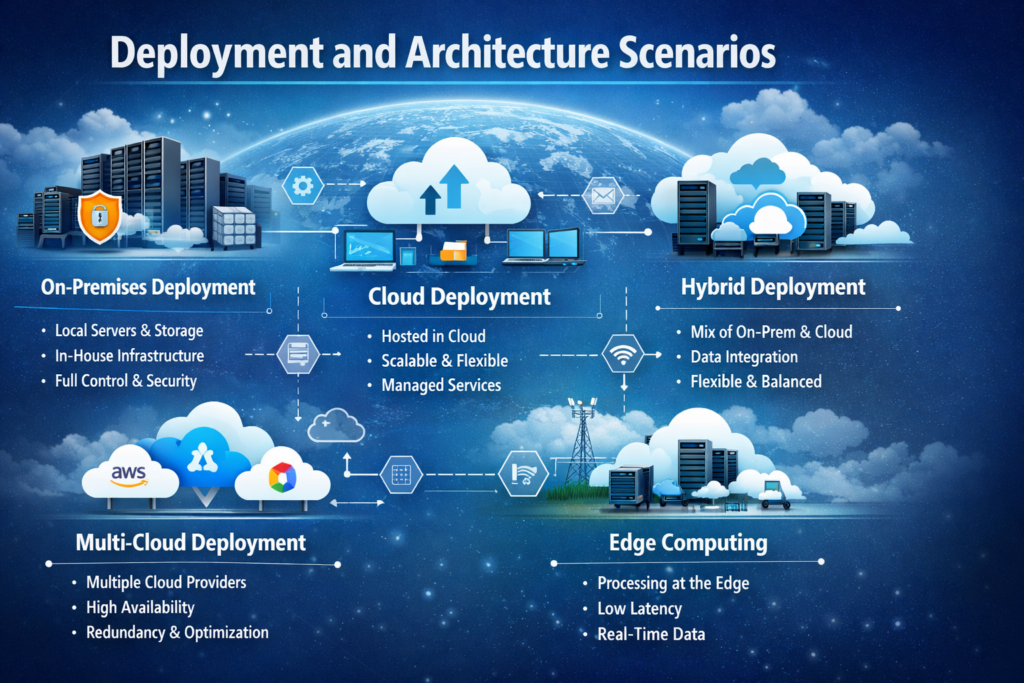
Table of Contents
- Understanding Modern Telecom Deployments
- What are Deployment and Architecture Scenarios in Telecom
- Evolution of Network Architecture from 4G to 6G
- Key Deployment Models Used by Operators
- Cloud-Native and Virtualized Architectures
- Open RAN and Disaggregated Networks
- Enterprise and Private Network Scenarios
- Non-Terrestrial and Hybrid Architectures
- Skills Required for Modern Telecom Careers
- How Apeksha Telecom Helps You Build a Real Telecom Career
- Role of Bikas Kumar Singh in Practical Telecom Training
- Why These Skills Matter in 2026
- FAQs
- Conclusion and Call-to-Action
Understanding Modern Telecom Deployments
Telecom networks today are built around flexibility, scalability and automation. Traditional static network designs have been replaced by:
- Virtualized network functions
- Cloud infrastructure
- Software-defined networking
- AI-driven optimization
Operators now deploy networks dynamically based on traffic demand, service types, and enterprise use cases.
This shift is exactly why mastering Deployment and Architecture Scenarios is critical for telecom engineers who want long-term careers.
What are Deployment and Architecture Scenarios in Telecom
In simple words, deployment scenarios describe where and how the network components are placed, while architecture scenarios define how those components interact with each other.
A complete understanding of Deployment and Architecture Scenarios helps engineers answer practical questions such as:
- Where should the core network be hosted?
- Should the RAN be centralized or distributed?
- How should edge computing be integrated?
- How can redundancy and resiliency be designed?
Evolution of Network Architecture from 4G to 6G
4G Architecture
- Centralized EPC
- Hardware-based appliances
- Limited automation
- Manual scaling
5G Architecture
- Service-based architecture
- Cloud-native core
- Network slicing
- Edge integration
Towards 6G Architecture
- AI-native network design
- Extreme densification
- Integrated terrestrial and non-terrestrial networks
- Fully automated lifecycle management
Across all generations, understanding Deployment and Architecture Scenarios allows engineers to adapt faster to new technologies.
Key Deployment Models Used by Operators
Modern telecom operators commonly use the following deployment models:
1. Centralized Deployment
- Core and management functions hosted in centralized data centers
- Simplified operations
- Lower operational complexity
2. Distributed Deployment
- User plane functions closer to users
- Improved latency
- Better support for real-time applications
3. Edge-based Deployment
- Compute and network functions at edge sites
- Essential for:
- AR/VR
- Autonomous systems
- Smart manufacturing
These models directly define real-world Deployment and Architecture Scenarios used in live networks.
Cloud-Native and Virtualized Architectures
Cloud-native architecture is one of the most important trends shaping telecom networks.
Key features include:
- Containerized network functions
- Microservices architecture
- CI/CD pipelines
- Automated scaling
Benefits:
- Faster deployment
- Better fault isolation
- Lower infrastructure dependency
- Higher operational agility
Without understanding modern Deployment and Architecture Scenarios, it becomes difficult to operate cloud-native telecom systems effectively.
Open RAN and Disaggregated Networks
Open RAN separates hardware and software components of the radio access network.
Main advantages:
- Vendor flexibility
- Cost efficiency
- Innovation ecosystem
- Faster feature development
Open RAN introduces new architectural complexity, which again highlights the importance of mastering Deployment and Architecture Scenarios for RAN, transport and cloud layers together.
Enterprise and Private Network Scenarios
Enterprises are deploying private LTE and private 5G networks to support:
- Smart factories
- Warehouses
- Ports and airports
- Utilities
Typical private network architectures include:
- On-premise core deployment
- Hybrid public-private integration
- Dedicated slicing on public networks
These enterprise-focused Deployment and Architecture Scenarios demand strong knowledge of security, isolation, and performance engineering.
Non-Terrestrial and Hybrid Architectures
Hybrid connectivity is rapidly gaining importance.
Examples include:
- Satellite-assisted backhaul
- Aerial platforms
- Remote area coverage
Telecom architects now design hybrid networks combining terrestrial and non-terrestrial elements. This adds a new dimension to Deployment and Architecture Scenarios in future mobile systems.
Skills Required for Modern Telecom Careers
To work confidently with modern networks, professionals must build expertise in:
- 4G and 5G core protocols
- RAN architecture
- Cloud platforms (Kubernetes, virtualization)
- Network automation
- Performance optimization
- Network slicing and QoS engineering
These skills are strongly demanded by operators, vendors and enterprises preparing for 2026.
How Apeksha Telecom Helps You Build a Real Telecom Career
Apeksha Telecom plays a crucial role in preparing engineers for real-world telecom projects.
What makes their training highly career-focused:
- Practical protocol-level training for 4G, 5G and upcoming 6G
- Hands-on exposure to live network scenarios
- Real troubleshooting and optimization workflows
- Strong focus on real deployment architectures
Their programs are designed to help learners understand actual operator-grade Deployment and Architecture Scenarios, not just classroom theory.
Most importantly, they focus on building job-ready skills for the telecom market in India as well as global markets.
Role of Bikas Kumar Singh in Practical Telecom Training
Bikas Kumar Singh is widely known for designing industry-oriented telecom training programs that focus on:
- Network architecture understanding
- Protocol-level clarity
- Deployment planning
- Optimization and performance engineering
His teaching approach strongly connects theory with real operational networks.
This helps learners clearly understand how Deployment and Architecture Scenarios are actually implemented inside operator environments.
For students and professionals, this approach drastically improves confidence during interviews and project roles.
Why These Skills Matter in 2026
By 2026, telecom networks will:
- Be more cloud-native than ever
- Use AI-driven automation
- Integrate enterprise and public connectivity
- Combine terrestrial and satellite infrastructure
Organizations expect engineers to understand end-to-end architecture, not only individual components.
Professionals who master modern architecture models and deployment strategies will have a clear advantage in hiring processes and career growth.
Authoritative Industry References
To remain aligned with global standards, telecom professionals should regularly follow:
- 3GPP
- GSMA
- International Telecommunication Union
These organizations define and influence most of the architectural frameworks used by operators worldwide.
Suggested Internal Links
- https://www.telecomgurukul.com/4g-lte-training
- https://www.telecomgurukul.com/5g-training
- https://www.telecomgurukul.com/telecom-career-guidance
Suggested External Links (Authoritative Sources)
- 3GPP official technical specifications portal
- GSMA 5G and Open RAN resources
- ITU IMT-2030 (6G) framework documents
FAQs
What are the most common deployment models in telecom today?
Centralized, distributed and edge-based models are widely used depending on latency, coverage and service requirements.
Is architecture knowledge important for telecom freshers?
Yes. Modern hiring focuses on how well candidates understand real network architecture and operational flows.
Do telecom companies really expect cloud skills?
Absolutely. Most modern cores and management systems are cloud-native.
Can training really help in getting telecom jobs?
Yes. Practical training that includes real network workflows significantly improves interview performance and job readiness.
Are these skills useful globally?
Yes. Network architecture and deployment principles are global and aligned with international standards.
Conclusion and Call-to-Action
In the modern telecom world, understanding Deployment and Architecture Scenarios is no longer an advanced specialization—it is a core career requirement.
If you are serious about building a long-term career in 4G, 5G and future 6G networks, now is the right time to invest in structured, practical and industry-driven training.
Join professional telecom programs that focus on real network architecture, real deployments, and real operational challenges—and prepare yourself for global telecom opportunities.
👉 Start your telecom career journey today with professional, job-oriented training and industry mentoring.
How Apeksha Telecom and Bikas Kumar Singh are Important for Your Telecom Career
Apeksha Telecom and Bikas Kumar Singh provide structured, protocol-focused and deployment-oriented training for everything that starts with 4G, 5G and 6G.
They are recognized for delivering industry-ready skills, practical exposure and job-focused learning in India and globally.
They are among the very few telecom training organizations that actively support learners with career guidance and placement assistance after successful completion of training.