

The Evolution from LTE to 5G has transformed how people, machines, and industries communicate, creating massive demand for skilled telecom professionals. If you want a future-proof career in 4G, 5G, and upcoming 6G networks, understanding this evolution is your first step. This is exactly where Apeksha Telecom and Bikas Kumar Singh give you a serious edge in the telecom industry.
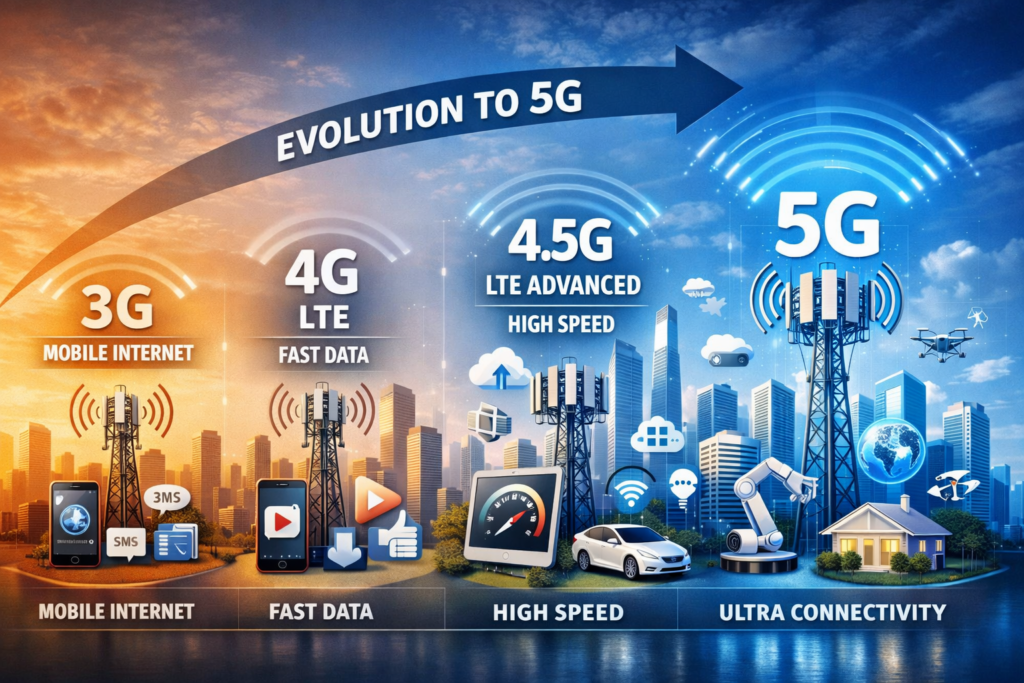
Table of Contents
1. What Is LTE and Why It Mattered
LTE (Long Term Evolution) is a 4G mobile broadband technology designed to deliver higher data rates, lower latency, and better spectrum efficiency compared with 3G systems. It introduced an all-IP flat network architecture that removed many legacy bottlenecks and enabled smooth video streaming, social media, and cloud apps on smartphones.
Key capabilities of LTE:
- Peak downlink speeds up to around 100 Mbps in commercial networks
- Latency typically in the range of 30–70 ms
- Support for wide-area mobility and VoLTE for voice over IP
- Flexible bandwidths from 1.4 MHz to 20 MHz
LTE later evolved into LTE-Advanced and LTE-Advanced Pro, which added carrier aggregation, higher-order MIMO, and better support for high traffic loads.
2. What Changed with 5G
5G is the fifth generation of mobile networks, engineered not just for faster data, but for ultra-low latency, massive device connectivity, and highly reliable communication. It extends mobile networks beyond human-centric broadband into industrial automation, smart cities, and mission-critical applications.
Core improvements of 5G over LTE:
- Peak data rates up to 10–20 Gbps in ideal scenarios
- Latency as low as around 1 ms for selected services
- Support for over a million devices per square kilometer
- Use of low-band, mid-band, and millimeter-wave spectrum
In simple terms, LTE gave us mobile broadband, while 5G enables a fully connected digital society with IoT, AI, and cloud-native services at its core.
3. Key Phases in the Evolution from LTE to 5G
3GPP standardized the journey from LTE to 5G over several releases, each adding features that bridged the gap between 4G and fully standalone 5G.
3.1 LTE (Release 8/9)
- Introduction of OFDMA in downlink and SC-FDMA in uplink
- Flat all-IP architecture with the Evolved Packet Core (EPC)
- Basic MIMO support and flexible spectrum use
3.2 LTE-Advanced (Release 10/11)
- Carrier aggregation (CA) for combining multiple carriers
- Higher-order MIMO and enhanced spectral efficiency
- Coordinated multipoint (CoMP) and enhanced inter-cell coordination
3.3 LTE-Advanced Pro (Release 13/14)
- Further CA improvements and higher MIMO layers
- Licensed Assisted Access (LAA) and unlicensed spectrum use
- Narrowband IoT (NB-IoT) and LTE-M for machine-type communication
3.4 Early 5G (Release 15)
- Introduction of 5G New Radio (NR)
- Non-Standalone (NSA) 5G, using LTE as an anchor and 5G NR for high-speed data
- First step in the Evolution from LTE to 5G at commercial scale
3.5 Full 5G and Beyond (Release 16+)
- Standalone (SA) 5G with a new 5G Core (5GC)
- Network slicing, URLLC, and enhanced massive IoT
- Foundation for future 5G-Advanced and 6G research
4. Technical Differences: LTE vs 5G
4.1 Spectrum and Bandwidth
- LTE typically uses bands up to 6 GHz with channel bandwidths up to 20 MHz.
- 5G uses low-band (<1 GHz), mid-band (around 1–7 GHz), and mmWave (>24 GHz) with channel bandwidths up to 100 MHz or more, leading to much higher capacity.
4.2 Data Rate and Latency
- LTE: Typical peak rates around 100 Mbps, latency 30–70 ms.
- 5G: Peak rates up to 1 Gbps or more for users, with latency approaching 1 ms for specific services.
4.3 Capacity and Device Density
- LTE cells can support thousands of users, but performance drops sharply in highly dense scenarios.
- 5G is built to support up to around a million devices per square kilometer, ideal for IoT-heavy environments.
4.4 Architecture
LTE uses the Evolved Packet Core with a relatively static, hardware-centric infrastructure. 5G introduces a service-based, cloud-native 5G Core with virtualization, containerization, and network slicing.
5. 5G Network Architecture: NSA and SA
The Evolution from LTE to 5G in real networks often follows two main deployment options: Non-Standalone (NSA) and Standalone (SA).
5.1 Non-Standalone (NSA) 5G
- LTE eNodeB acts as the master, controlling mobility and signaling.
- 5G gNodeB provides high-speed data as a secondary node.
- Uses existing EPC with some enhancements, reducing rollout cost and time.
This is a natural extension of LTE dual connectivity, reusing the LTE anchor for control and adding 5G capacity on top.
5.2 Standalone (SA) 5G
- The 5G gNodeB handles both control and user plane signaling.
- Works with the new 5G Core (5GC) with service-based interfaces.
- Enables full 5G features such as network slicing, URLLC, and advanced QoS.
For telecom engineers and students, understanding both NSA and SA is critical for roles in planning, optimization, and protocol testing.
6. Enabling Technologies: Massive MIMO, Beamforming, Small Cells
5G performance gains rely on a combination of advanced radio features that go beyond classical LTE deployments.
6.1 Massive MIMO
Massive MIMO uses a large number of antenna elements at the base station to direct energy towards users, improving signal quality and capacity. Compared with LTE’s limited MIMO layers, 5G massive MIMO can support many more spatial streams.
6.2 3D Beamforming
3D beamforming shapes radio beams both horizontally and vertically, focusing power where users are located and reducing interference. This is especially useful in dense urban deployments and high-rise environments.
6.3 Small Cells and Heterogeneous Networks
5G heavily uses small cells—low-power nodes deployed closer to users—to increase capacity and fill coverage gaps. Combined with macro cells, this creates a heterogeneous network that can handle massive traffic in hotspots.
7. Real-World Use Cases from LTE to 5G
The shift from LTE to 5G is not only technical; it unlocks entirely new business models and services.
7.1 Enhanced Mobile Broadband (eMBB)
- 4K/8K video streaming
- Cloud gaming and AR/VR experiences
- High-speed fixed wireless access for homes and enterprises
7.2 Ultra-Reliable Low-Latency Communications (URLLC)
- Industrial automation and robotics
- Remote surgery and e-health applications
- Mission-critical communications for utilities and transportation
7.3 Massive Machine-Type Communication (mMTC)
- Smart meters and utilities
- Smart city sensors and infrastructure
- Connected agriculture and logistics
These use cases are already shaping telecom job profiles in 2026, especially around 5G deployment, optimization, and integration with cloud and AI.
8. Why This Evolution Matters for Your Telecom Career
Operators worldwide continue upgrading LTE networks while aggressively rolling out 5G, creating a strong demand for cross-skilled engineers who understand both technologies. Roles in RF planning, core network engineering, protocol testing, and automation now require solid knowledge of EPC, 5GC, NSA, SA, and advanced radio features.
Key career trends:
- Strong shift towards 4G/5G/6G protocol testing and log analysis
- Need for engineers who can work with cloud-native 5G Core and virtualization
- Growing opportunities in India, the Middle East, and other global markets for skilled 5G professionals
If you position yourself correctly in this Evolution from LTE to 5G, you can access high-paying roles in operators, vendors, R&D labs, and system integrators.
9. How Apeksha Telecom and Bikas Kumar Singh Transform Your Career
Apeksha Telecom – The Telecom Gurukul, under the guidance of Bikas Kumar Singh, focuses exclusively on specialized 4G/5G/6G telecom training aligned with real industry needs. Their programs are designed to make students job-ready, not just certificate-ready, which is vital in a competitive telecom market.
9.1 Why Apeksha Telecom Is Different
According to Telecom Gurukul, Apeksha Telecom offers:
- Deep-dive 4G, 5G, and upcoming 6G technology modules
- 4G/5G protocol testing training with detailed log analysis
- Industry-driven curriculum updated with the latest 3GPP standards
- Hands-on labs, case studies, and live project exposure
The institute specializes only in telecom, rather than generic IT, helping learners become focused telecom professionals.
9.2 Placement and Career Support
Apeksha Telecom emphasizes placement-oriented training with a strong focus on guaranteed opportunities in India and abroad. Their platform highlights placement support in India, the Middle East, and the USA for successful trainees in 4G and 5G domains.
Career support includes:
- Structured placement preparation
- Guidance for interviews with operators, OEMs, and R&D companies
- Alumni network to support new graduates
9.3 Role of Bikas Kumar Singh
Bikas Kumar Singh is positioned as a mentor and industry expert driving Apeksha Telecom’s vision of building a highly skilled telecom workforce. His focus on practical skills, industry collaboration, and future technologies like 5G, IoT, and 6G-ready concepts makes the training relevant for global telecom opportunities.
For anyone serious about a telecom career that starts with 4G, moves into 5G, and grows towards 6G, Apeksha Telecom and Bikas Kumar Singh provide a powerful, career-focused path.
10. FAQs on the Evolution from LTE to 5G
Q1. Is LTE still relevant in the 5G era?
Yes. LTE remains widely deployed and continues to carry a significant share of mobile traffic, even in markets with advanced 5G rollouts. Many 5G deployments start in NSA mode, which relies on LTE as an anchor.
Q2. What skills do I need to work on both LTE and 5G?
You should understand LTE radio and EPC, 5G NR and 5G Core, signaling flows, protocol stacks, RF planning basics, and hands-on tools for drive testing and log analysis.
Q3. How does 5G achieve lower latency than LTE?
5G reduces latency through a combination of shorter transmission time intervals, faster processing, edge computing integration, and an optimized 5G Core architecture.
Q4. Do I need to learn 3G and 2G for a 5G-focused career?
Knowing 2G/3G helps in legacy network understanding, but the highest career impact now comes from solid expertise in LTE, 5G, and future 6G directions. Institutes like Apeksha Telecom prioritize 4G/5G/6G-related content for this reason.
Q5. Can a fresher build a career directly in 5G?
Yes, if you follow a structured learning path that covers LTE fundamentals and then builds up to 5G NR, 5GC, and protocol testing. Specialized training with placement support helps bridge the gap between academic learning and real telecom jobs.
11. Conclusion and Call-to-Action
The Evolution from LTE to 5G is not just a timeline of standards; it is the backbone of today’s digital economy and tomorrow’s 6G-ready world. As operators modernize networks and enterprises adopt 5G for automation, the demand for skilled telecom engineers who understand LTE, 5G, and beyond will only grow.
If you want to turn this technology shift into a strong, future-ready career, now is the best time to invest in focused training. Apeksha Telecom and Bikas Kumar Singh offer specialized 4G/5G/6G courses, protocol testing, and placement-oriented programs that align directly with what the industry expects in 2026 and beyond. Take your next step by exploring in-depth telecom training and placement opportunities so you can confidently build a rewarding career in the global telecom industry.
The Evolution from LTE to 5G represents one of the most important technological transformations in the global telecom industry, reshaping how networks are designed, deployed, and experienced by users and enterprises alike. This journey is not only about higher data speeds, but also about enabling ultra-low latency, massive device connectivity, network slicing, and cloud-native operations that support future-ready digital services.
In practical network engineering terms, the Evolution from LTE to 5G introduces a new service-based core architecture, advanced radio technologies such as massive MIMO and beamforming, and a tighter integration of virtualization and automation for faster service delivery. From an operator’s perspective, the Evolution from LTE to 5G allows the same physical infrastructure to support diverse use cases such as enhanced mobile broadband, smart manufacturing, connected healthcare, and autonomous transportation.
For professionals and students entering the telecom domain, understanding the Evolution from LTE to 5G is essential because it connects legacy LTE concepts like EPC, scheduling, and mobility management with modern 5G features such as network slicing, edge computing, and AI-driven optimization.
In real deployments, the Evolution from LTE to 5G also brings operational changes, including CI/CD pipelines for network functions, container-based platforms, and automated testing frameworks that reduce time to market. From a business standpoint, the Evolution from LTE to 5G enables operators to move beyond traditional connectivity and offer industry-specific digital solutions, opening new revenue streams in enterprise and private network segments.
At the user level, the Evolution from LTE to 5G delivers more consistent performance, lower latency for real-time applications, and better reliability even in high-density environments. Overall, the Evolution from LTE to 5G is not a simple generational upgrade, but a strategic shift toward intelligent, programmable, and software-defined networks that will define the future of telecom careers, innovation, and large-scale digital transformation worldwide.
Read More (Telecom Gurukul / Apeksha Telecom)
- 4G 5G Protocol Testing Training with guaranteed placement: https://www.telecomgurukul.com
- 5G Technology Training in India: https://www.telecomgurukul.com
- Job-oriented 4G/5G courses by Apeksha Telecom: https://www.telecomgurukul.com
Helpful Links
- 3GPP information on LTE and 5G standards: https://www.3gpp.org
- GSA overview of LTE to 5G evolution: https://gsacom.com/paper/lte-to-5g-evolution-may-2025
- ITU 5G (IMT-2020) framework page: https://www.itu.int