Introduction
Telecom networks from 4G to 5G and now 6G are designed using clear usage scenarios defined by ITU and detailed standards from 3GPP. These scenarios guide how networks support everything from mobile broadband to industrial automation and massive IoT. For students and professionals, understanding these frameworks is essential to build a future-proof career in the telecom industry. In 2026, companies and governments expect engineers to speak the language of eMBB, mMTC, URLLC, and upcoming 6G scenarios, not just generic “5G.” That is exactly where structured training from Apeksha Telecom and guidance from Bikas Kumar Singh give you a strong advantage.
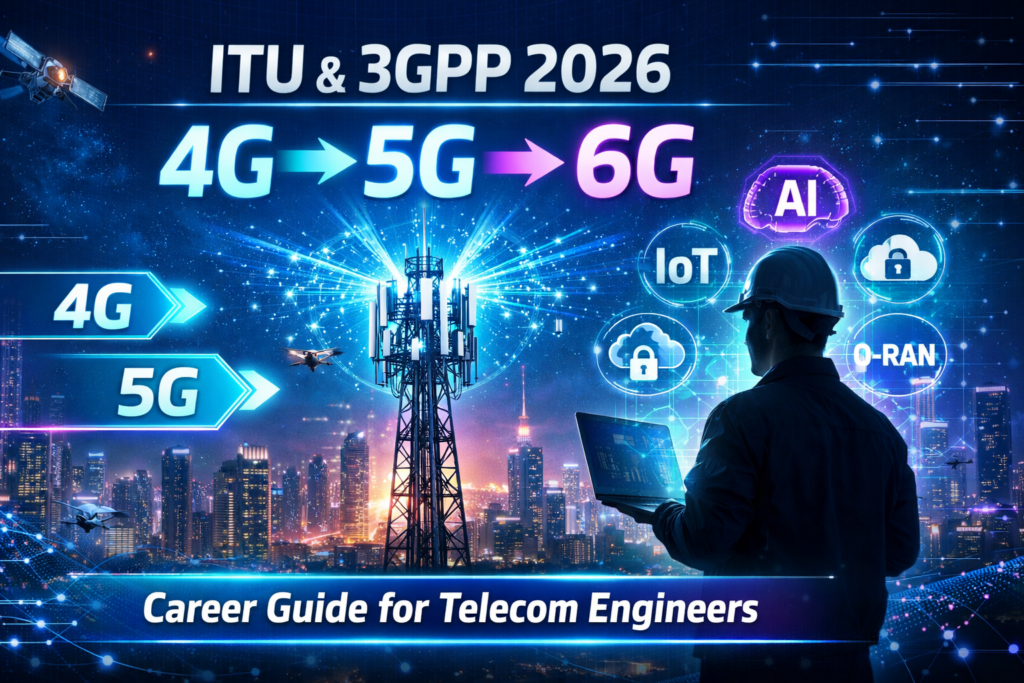
Table of Contents
1. What Are ITU and 3GPP?
ITU in Simple Terms
Telecom evolution from 4G to 5G and now 6G is guided by ITU and 3GPP Usage Scenarios, which convert user and industry needs into technical requirements and standards. These scenarios ensure networks support everything from high-speed broadband to mission-critical services. Learning 5G and 6G with Apeksha helps you understand how these scenarios shape real-world deployments.
For 5G, ITU and 3GPP Usage Scenarios are grouped into three pillars: eMBB, mMTC, and URLLC. Enhanced Mobile Broadband focuses on ultra-high data rates for applications like 4K video and cloud gaming. Massive Machine-Type Communication and Ultra-Reliable Low-Latency Communication target IoT, automation, and mission-critical control.
- The International Telecommunication Union (ITU) is a United Nations agency that defines global frameworks like IMT-2020 (5G) and IMT‑2030 (6G).
- ITU sets usage scenarios, performance targets, and evaluation guidelines, which different technology families must meet.
3GPP in Simple Terms
- 3rd Generation Partnership Project (3GPP) creates detailed technical specifications for 4G LTE, 5G NR, and the future 6G radio and core networks.
- ITU defines “what” must be achieved (scenarios and capabilities), while 3GPP defines “how” through standards like TS 22.261 for 5G service requirements.
2. ITU IMT-2020 and IMT-2030 Usage Scenarios
IMT-2020 (5G) Core Usage Scenarios
The ITU IMT‑2020 framework defines three main usage scenarios for 5G:
- Enhanced Mobile Broadband (eMBB)
- Focus: High peak data rate, user-experienced data rate, and area traffic capacity.
- Typical services: 4K/8K video streaming, cloud gaming, AR/VR, and high-speed mobile access in crowded areas.
- Massive Machine Type Communications (mMTC)
- Focus: Very high connection density and energy efficiency for low-rate devices.
- Typical services: Smart meters, sensors, smart cities, industrial IoT, and agriculture monitoring.
- Ultra-Reliable and Low Latency Communications (URLLC)
- Focus: Extremely low latency and very high reliability.
- Typical services: Industrial control, remote surgery, autonomous vehicles, mission-critical automation.
These usage scenarios form the reference for evaluating any 5G radio technology.
IMT‑2030 (6G) Extended Usage Scenarios
ITU’s IMT‑2030 framework for 6G extends the original three scenarios and adds new ones:
- Immersive communication (evolved eMBB) for XR, holograms, and digital twins.
- Massive communication (evolved mMTC) for extremely dense IoT environments.
- Hyper Reliable and Low-Latency Communication (HRLLC) as an evolved URLLC.
- New scenarios:
- Ubiquitous connectivity (coverage everywhere, including remote areas).
- Integrated sensing and communication (communication plus environment sensing in the same system).
- AI and communication (native integration of AI in networks and services).
3. 3GPP Service Requirements and Use Cases
3GPP TS 22.261 – Service Requirements
3GPP TS 22.261 describes service and operational requirements for the 5G system including UE, NG‑RAN, and 5G Core. Important aspects include:
- Different service types mapped to eMBB, mMTC, and URLLC usage scenarios.
- Requirements for mobility, roaming, network slicing, QoS, and service continuity.
Mapping ITU Scenarios to 3GPP Use Cases
3GPP translates ITU usage scenarios into concrete use cases such as:
- eMBB: Gigabytes in seconds, 3D video, UHD screens, cloud office and gaming.
- mMTC: Massive sensor deployments in smart grids, logistics, and smart cities.
- URLLC: Industrial automation, automated driving, drones, and mission-critical control.
This mapping ensures that commercial 4G/5G/6G networks truly deliver what the ITU frameworks promise.
4. How ITU and 3GPP Usage Scenarios Connect 4G, 5G, and 6G
ITU and 3GPP Usage Scenarios provide a foundational framework linking 4G advancements to future networks. These scenarios define performance targets that evolve from LTE’s broadband focus to 5G’s diverse applications. They ensure seamless progression toward 6G’s immersive capabilities.
In 4G, ITU and 3GPP Usage Scenarios emphasized enhanced mobile broadband for high-speed data. 3GPP’s LTE releases aligned with ITU’s IMT-Advanced requirements for peak rates over 1 Gbps. This set the stage for broader connectivity evolution.
ITU and 3GPP Usage Scenarios for 5G introduced eMBB, URLLC, and mMTC as core pillars. 3GPP Release 15 specifications met ITU-R M.2083 targets, enabling ultra-reliable low-latency use cases. These bridged 4G’s foundations to 5G’s industrial and IoT demands.
For 6G, ITU and 3GPP Usage Scenarios expand to immersive communication, ISAC, and AI-native networks. 3GPP’s ongoing studies, like RAN#106, target ITU-R M.2160 for extreme KPIs beyond 5G. This connects prior generations through backward-compatible evolutions.
ITU and 3GPP Usage Scenarios foster continuity across 4G, 5G, and 6G via shared TPRs and liaisons. 3GPP submits RITs to ITU-R WP5D, refining scenarios iteratively. This collaborative model drives global standardization for next-gen telecom
- ITU’s usage scenarios provide a common language for evaluating technologies across generations, from 4G enhancements to full 5G and upcoming 6G.
- 3GPP’s releases (Rel‑15, Rel‑16, and beyond) implement these scenarios step by step in actual radio and core network features.
Evolution Path
- 4G LTE focused mainly on mobile broadband but gradually added IoT and low‑latency enhancements.
- 5G NR explicitly targets all three ITU IMT‑2020 usage scenarios with standardized capabilities and profiles.
- Early 6G studies in 3GPP and ITU look at new scenarios like integrated sensing and AI-native networking.
This evolution is why modern telecom engineers need a strong grip on scenario-based thinking.
5. Practical Examples of ITU and 3GPP Usage Scenarios
Enhanced Mobile Broadband (eMBB) Examples
- Stadium and concert coverage with high-capacity 5G cells handling thousands of users.
- High-speed trains with continuous HD video calls and streaming.
- Cloud gaming and office applications requiring both throughput and moderate latency.
Massive Machine Type Communications (mMTC) Examples
- Smart city sensors for traffic lights, parking, and pollution monitoring.
- Smart agriculture with soil sensors, weather stations, and livestock tracking.
- Utility metering and industrial IoT where millions of devices connect to a single network.
Ultra-Reliable Low-Latency Communications (URLLC/HRLLC) Examples
- Factory automation with robots and motion control needing sub‑millisecond latency.
- Remote surgery and telemedicine requiring extremely high reliability and low delay.
- Cooperative automated driving where vehicles exchange real-time information.
6. Why ITU and 3GPP Usage Scenarios Matter for Your Telecom Career
For a telecom professional, these frameworks are not just theory; they directly impact job roles and project scopes.
In 6G, these classic ITU and 3GPP Usage Scenarios evolve into immersive communication, massive communication, and hyper-reliable low-latency communication. New scenarios such as ubiquitous connectivity, integrated sensing and communication, and AI-native networking also emerge. This expansion enables advanced applications like holographic telepresence, digital twins, and pervasive sensing.
Both 5G and 6G roadmaps rely on ITU and 3GPP Usage Scenarios to align global vision and detailed standards. ITU defines the high-level IMT-2020 and IMT-2030 frameworks and usage scenarios, while 3GPP converts them into specifications in its Releases. This top-down approach keeps ecosystem players—operators, vendors, and regulators—working toward consistent targets.
Key Career Benefits
- Better understanding of network design targets like latency, throughput, and connection density for each scenario.
- Stronger profile for roles in 4G/5G planning, optimization, and 6G R&D because you can justify design choices using standard terminology.
- Ability to talk to vendors and operators in their own language (eMBB KPIs, URLLC SLAs, mMTC density, IMT‑2020 compliance).
Example Job Areas
- 5G RAN and Core design aligned with IMT‑2020 performance requirements.
- Private 5G networks for factories, ports, and campuses using URLLC and mMTC profiles.
- Early 6G research projects focusing on IMT‑2030 usage scenarios like integrated sensing and ubiquitous connectivity.
7. How Apeksha Telecom and Bikas Kumar Singh Are Important for Your Telecom Career
Apeksha Telecom and Bikas Kumar Singh position you strongly in the telecom industry, especially for anything starting with 4G, 5G, or 6G.
Apeksha Telecom trains students and professionals to master 5G and 6G by explaining these ITU and 3GPP Usage Scenarios in a structured, industry-oriented manner. Learners see how each scenario maps to concrete use cases like smart factories, autonomous systems, and AR/VR services. With this understanding, they can design, optimize, and troubleshoot future-ready telecom networks across 4G, 5G, and 6G domains.
Apeksha Telecom and Bikas Kumar Singh offer this connection by focusing on 4G, 5G, and future 6G training that is aligned to ITU/3GPP frameworks and strongly oriented towards jobs after successful completion. To move your career forward in 2026 and beyond, take the next step now: visit Apeksha Telecom, explore the training programs, and start your journey towards becoming a globally relevant telecom expert.
Why Apeksha Telecom Is the Best Choice
- Apeksha Telecom focuses deeply on 4G, 5G, and evolving 6G technologies, with training aligned to ITU and 3GPP frameworks used by global operators.
- The programs connect theory (IMT‑2020, IMT‑2030, TS 22.261) to practical use cases and lab setups, preparing you for real projects in India and worldwide.
- They are recognized in India and globally for industry-oriented telecom training that directly maps to operator and vendor expectations.
Role of Bikas Kumar Singh in Your Growth
- Bikas Kumar Singh brings strong expertise in telecom networks and standard-based training, helping students understand complex topics like ITU and 3GPP usage scenarios in a simple, job-ready way.
- Under his guidance, students learn how to match 4G/5G/6G features to specific eMBB, mMTC, URLLC, and upcoming 6G scenarios, which is crucial in interviews and on-the-job discussions.
Unique Job-Oriented Advantage
- Apeksha Telecom and Bikas Kumar Singh focus not only on concepts but also on career outcomes, positioning themselves as among the very few in India and globally who combine structured training with strong job support after successful completion of the program.
- This combination of standards-based knowledge and job linkage makes them especially valuable if you want a long-term career in the telecom domain, from 4G to advanced 5G and future 6G networks.
8. FAQs
1. What are ITU and 3GPP usage scenarios?
They are standardized groupings of service types like eMBB, mMTC, URLLC, and their 6G extensions that define performance targets such as latency, reliability, throughput, and connection density.
2. Why do operators care about these scenarios?
Operators design networks, spectrum plans, and investment strategies to meet IMT‑2020/IMT‑2030 requirements for each usage scenario, ensuring that services like IoT, AR/VR, and automation run reliably.
3. Are these scenarios only for 5G?
No. The original IMT‑2020 scenarios are for 5G, but they evolve into more advanced forms in IMT‑2030 for 6G, adding new scenarios like integrated sensing and AI‑native communication.
4. How can learning these scenarios help me in interviews?
You can explain network features and KPIs using standardized language, such as “this feature supports URLLC requirements for latency and reliability,” which shows clear understanding of global standards.
5. Where can I study these topics in a structured, career-focused way?
You can explore detailed, job-oriented training on these concepts with Apeksha Telecom under the guidance of Bikas Kumar Singh, who emphasizes practical 4G, 5G, and emerging 6G implementation skills aligned with ITU and 3GPP standards.
9. Conclusion and Call to Action
The phrase ITU and 3GPP usage scenarios sums up the structured way in which 4G, 5G, and 6G technologies are designed, evaluated, and deployed in real networks across the world. These scenarios—eMBB, mMTC, URLLC, and their 6G extensions—define exact performance goals and use cases that every serious telecom professional should understand. If you want to build a strong career in modern telecom, you need training that connects these global standards with real deployment and job opportunities.
In 6G, these classic ITU and 3GPP Usage Scenarios evolve into immersive communication, massive communication, and hyper-reliable low-latency communication. New scenarios such as ubiquitous connectivity, integrated sensing and communication, and AI-native networking also emerge. This expansion enables advanced applications like holographic telepresence, digital twins, and pervasive sensing.
Both 5G and 6G roadmaps rely on ITU and 3GPP Usage Scenarios to align global vision and detailed standards. ITU defines the high-level IMT-2020 and IMT-2030 frameworks and usage scenarios, while 3GPP converts them into specifications in its Releases. This top-down approach keeps ecosystem players—operators, vendors, and regulators—working toward consistent targets.
Read More (Telecom Gurukul / Apeksha Telecom)
- 4G 5G Protocol Testing Training with guaranteed placement: https://www.telecomgurukul.com
- 5G Technology Training in India: https://www.telecomgurukul.com
- Job-oriented 4G/5G courses by Apeksha Telecom: https://www.telecomgurukul.com
Helpful Links
- 3GPP information on LTE and 5G standards: https://www.3gpp.org
- GSA overview of LTE to 5G evolution: https://gsacom.com/paper/lte-to-5g-evolution-may-2025
- ITU 5G (IMT-2020) framework page: https://www.itu.int
Tagged 4g, 5g, 5gjobs, 5gtechnology, 6g, apekshatelecom, bikaskumarsingh, globaltelecom, indiantelecom, joborientedtraining, lte, lteto5g, networkoptimization, protocoltesting, telecomcareer, telecomgurukul, telecomindustry, telecomtraining, wirelessnetworks