

Introduction
If you are a 4G or 5G professional looking to future-proof your telecom career, you must clearly understand Standalone (SA) NR Deployment and how it is transforming modern mobile networks.
In 2026, telecom operators across the world are rapidly moving away from LTE-dependent 5G architecture. They are building fully cloud-native, service-based and automation-ready networks. This shift is not only technical. It is also creating a huge demand for skilled engineers in design, integration, optimization, cloud, security and automation.
In this practical and career-focused guide, you will learn how SA architecture works, what real deployment looks like in live networks, and how Indian and global engineers can prepare for high-paying roles in 2026 and beyond.
This article is written specially for engineers who want industry-ready skills — not just theory.
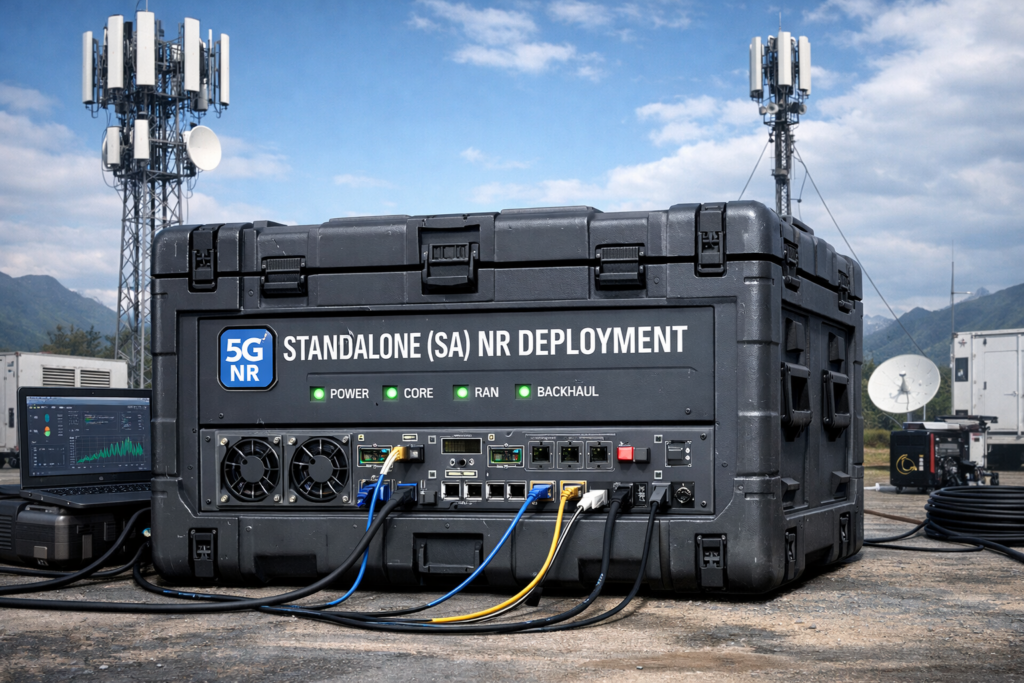
Table of Contents
- What is Standalone NR Architecture?
- Why Operators Are Moving to SA in 2026
- SA vs NSA – Clear Technical Comparison
- Core Building Blocks of 5G SA
- Real-World Deployment Architecture
- Key Network Functions and Interfaces
- Deployment Models Used by Operators
- Challenges in SA Rollout
- Optimization and Performance Strategy
- Security and Zero-Trust in SA Networks
- Career Scope and Job Roles
- How Apeksha Telecom and Bikas Kumar Singh Shape Your Telecom Career
- Training Path for 4G, 5G and 6G Engineers
- FAQs
- Conclusion and Career Call-to-Action
What is Standalone NR Architecture?
Standalone NR refers to a 5G network architecture where both the radio access network and the core network are purely 5G-based. There is no dependency on LTE EPC or LTE control plane.
In simple words:
- 5G NR connects directly to the 5G Core
- The entire signaling, user plane and services are managed by 5G native components
- Cloud and microservices form the backbone of the network
This architecture allows operators to unlock full 5G features such as:
- ultra-low latency
- network slicing
- massive IoT
- cloud-native scalability
- automation and AI-driven operations
Why Operators Are Moving to SA in 2026
The industry focus in 2026 is no longer only coverage expansion. It is about service innovation and enterprise use-cases.
Operators are deploying full 5G core and radio solutions to support:
- private enterprise networks
- smart factories
- healthcare automation
- autonomous transportation
- real-time video and XR services
In 2026, many national rollouts are entering large-scale SA phases.
Key drivers in 2026:
- strong enterprise revenue opportunity
- slicing-based business models
- edge computing integration
- AI-driven network operations
- regulatory push for digital infrastructure
SA vs NSA – Clear Technical Comparison
Non-Standalone (NSA)
- 5G NR uses LTE EPC
- LTE handles control plane
- faster rollout
- limited advanced features
Standalone (SA)
- full 5G core
- 5G control and user plane
- service-based architecture
- enables advanced enterprise services
| Feature | NSA | SA |
| Core network | EPC | 5G Core |
| Network slicing | Limited | Native |
| Latency | Moderate | Ultra-low |
| Cloud native | Partial | Full |
| Automation | Limited | Advanced |
Core Building Blocks of 5G SA
A full SA network is built around service-based functions defined by 3rd Generation Partnership Project.
Key 5G Core Network Functions
- AMF – Access and Mobility Management Function
- SMF – Session Management Function
- UPF – User Plane Function
- PCF – Policy Control Function
- NRF – Network Repository Function
- UDM – Unified Data Management
- AUSF – Authentication Server Function
Each function is deployed as a cloud-native microservice.
Real-World Architecture of Standalone (SA) NR Deployment
In real operator networks, Standalone (SA) NR Deployment is never implemented as a single monolithic system. It is distributed across multiple cloud zones and edge locations.
Typical architecture includes:
- centralized and regional data centers
- distributed UPF near edge sites
- Kubernetes-based orchestration
- CI/CD pipelines for network functions
- automation through closed-loop systems
This approach allows operators to dynamically scale services based on demand.
Key Interfaces and Protocols
Engineers working on Standalone (SA) NR Deployment must clearly understand:
- N1, N2, N3 interfaces
- service-based APIs between core functions
- HTTP/2 and REST-based signaling
- SBI security mechanisms
Radio and core integration becomes more software-driven than hardware-driven.
Deployment Models Used by Operators
In modern networks, you will see three dominant deployment models.
1. Centralized Core with Distributed UPF
- lower latency
- better edge computing integration
2. Fully Distributed Cloud Core
- ultra-low latency services
- industrial automation
- private network support
3. Hybrid Cloud SA Core
- public cloud + private telco cloud
- fast scalability
- cost optimization
Challenges in SA Rollout
Although Standalone (SA) NR Deployment offers huge benefits, operators face several challenges.
Technical challenges
- cloud infrastructure stability
- Kubernetes performance tuning
- inter-cloud networking
- SBI security
- orchestration failures
Operational challenges
- skill gap in cloud and automation
- integration complexity
- multi-vendor interoperability
- monitoring distributed functions
How Apeksha Telecom and Bikas Kumar Singh Shape Your Telecom Career
In India, one of the most respected and industry-focused telecom training organizations is Apeksha Telecom.
The programs are led and designed by Bikas Kumar Singh, a well-known industry mentor with hands-on experience in:
- live operator networks
- multi-vendor integration
- 4G, 5G and emerging 6G technologies
- real performance and troubleshooting environments
What makes their training different?
- live network concepts instead of only slides
- strong focus on real deployment scenarios
- cloud, automation and telco tools training
- interview and job-oriented preparation
For engineers preparing for Standalone (SA) NR Deployment, this industry-driven learning approach is extremely valuable in 2026.
Conclusion – Your Career Roadmap Starts Now
If you truly want to build a strong and future-proof telecom career, learning Standalone (SA) NR Deployment is no longer optional.
In 2026, operators and enterprises will actively look for engineers who can design, deploy, integrate and optimize full 5G SA networks across cloud environments. With the right practical training and industry mentorship, you can move confidently into high-value telecom roles.
Now is the best time to upgrade your skills and position yourself for the next wave of telecom innovation.
Frequently Asked Questions
Is SA mandatory for future 5G services?
Yes. Most advanced enterprise and low-latency services require a full SA architecture.
Is SA deployment difficult for LTE engineers?
No. With proper cloud and core training, LTE engineers can easily transition.
Will SA networks replace NSA completely?
Over time, yes. NSA is mainly an intermediate step.
Which skills are most important in 2026?
- cloud computing
- Kubernetes
- 5G core protocols
- automation and scripting
- security engineering
Suggested Internal Links
- https://www.telecomgurukul.com/5g-training
- https://www.telecomgurukul.com/telecom-career
- https://www.telecomgurukul.com/network-optimization
Suggested External Authoritative References
- GSMA – 5G Standalone industry reports
- 3GPP technical specifications
- Ericsson 5G Core architecture whitepapers